5 Easy 3D Printing Ideas That Take Under 2 Hours
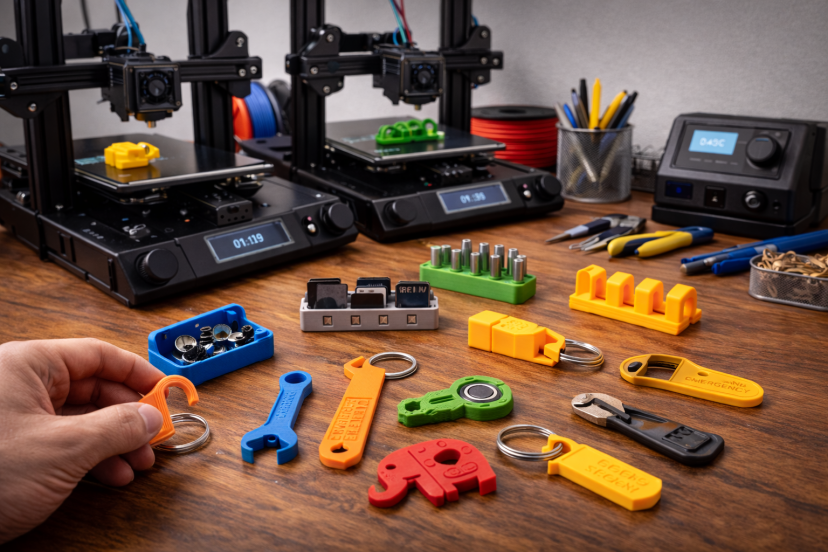
You fire up your printer, excited to start something new—then notice the model will take 14 hours. Just like that, your motivation drops. Long prints can feel overwhelming, and the longer they run, the more chances there are for something to go wrong. A small leveling issue or temperature tweak can waste hours of time and filament. Instead, focus on easy 3d printing ideas that take under two hours. Quick projects keep the hobby fun, reduce frustration, and help you improve your skills without turning every print into a marathon.
1. Cable Management Clips
Messy cables ruin even the cleanest workspace. Instead of buying plastic organizers, print your own.
Simple cable clips use very little filament and print fast—often in 30 to 60 minutes. Even better, you can customize the width for different cords. Need one for a thick power cable? Resize it. Want a slim version for charging wires? Adjust it in seconds.
Because they’re small, these prints allow you to test temperature settings and bridging performance. If you’re dialing in a new filament, this is a perfect trial run.
Why it’s easy:
- Small footprint
- Minimal supports
- Low filament usage
- Beginner-friendly design
You can even print a batch in one go.
2. Custom Phone Stand
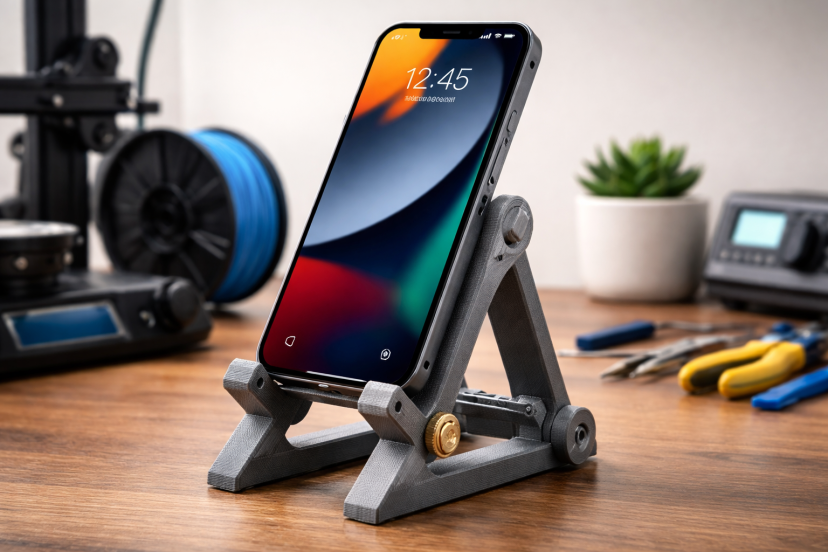
A phone stand is one of the most practical beginner projects. You can design a minimal angled stand that prints flat without supports. Most versions take 60 to 90 minutes depending on your layer height.
What makes this project great? You learn about angles, structural strength, and infill patterns. A 15% gyroid infill works surprisingly well for small stands.
Moreover, you can personalize it. Add your initials. Adjust the viewing angle. Create a charging slot. That flexibility makes 3D printing powerful.
Pro tip: Keep wall thickness slightly thicker for durability. Quick prints don’t mean fragile prints.
3. Drawer Organizers
Here’s where function meets satisfaction.
Small modular drawer organizers print quickly and help declutter your desk. Instead of buying expensive storage systems, print compartments sized exactly for your tools.
You can create:
- Bit holders
- SD card trays
- Small screw containers
- Hobby knife slots
Better yet, once you dial in a single module, you can duplicate it and print multiple at once.
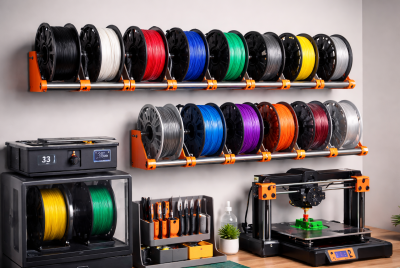
For hobbyists looking to upgrade their setup, pairing these prints with proper maintenance gear makes a difference. If you haven’t already, explore this helpful guide on essential 3D printer tools.
Good tools plus smart organization equals smoother prints.
4. Keychain Tools & Tags
Keychains are underrated practice pieces.
You can print:
- Name tags
- Mini bottle openers
- Hex wrench holders
- Emergency tool cards
These prints usually take under an hour. They’re also perfect for experimenting with dual colors or filament swaps mid-print.
Additionally, small objects teach you precision. Tiny layer shifts or temperature inconsistencies become obvious. Fixing them improves your overall print quality.
If you sell prints locally or online, keychains also make great low-cost test products.
5. Mini Planters for Desks
Mini geometric planters are quick, stylish, and fun.
A small succulent pot prints in about 90 minutes. Because most designs are hollow and lightweight, they require minimal infill. That reduces time and filament use.
You can experiment with:
- Spiral vase mode
- Textured walls
- Multi-color layers
- Drainage hole integration
These prints also introduce you to surface finishing. Light sanding or matte filament enhances the look.
Even better, they make thoughtful gifts.
Essential Tools for Faster, Cleaner Prints
Quick projects demand clean execution. You don’t want a failed print at 90 minutes.
Here are five highly rated Amazon products that hobbyists consistently rely on:
- Creality Ender 3 V3 SE 3D Printer – Reliable, beginner-friendly, and fast setup.
- SUNLU PLA Filament (1.75mm) – Consistent diameter for smoother prints.
- Stainless Steel Nozzle Set – Multiple sizes for different detail levels.
- 3D Printing Tool Kit with Deburring Tool – Designed to remove sharp edges and improve overall print quality.
- Official Creality Glass Build Plate – Improves adhesion and bottom-layer quality.
These tools minimize troubleshooting and reduce failed prints, especially when working on small, detailed models.
What Makes a Print “Easy”?
Not every small model qualifies as easy. Size helps, but smart design matters more.
First, look for minimal supports. The less support material you use, the less cleanup you face afterward. That saves time and reduces the risk of damaging the final piece.
Next, choose simple geometry. Flat bases, balanced weight distribution, and clean overhang angles improve stability during printing. When a model sits firmly on the build plate, failure rates drop dramatically.
Print time also matters. Projects under two hours keep motivation high and troubleshooting manageable. If something goes wrong, you haven’t lost half a day.
Finally, stick with low material complexity. PLA remains the most forgiving filament for most hobbyists. It prints at lower temperatures, adheres well, and warps less than many alternatives.
When you combine these factors, you create the perfect setup for fast improvement. That’s the real advantage of easy 3d printing ideas. They remove unnecessary friction and let you focus on building skill with every layer.
Why Quick Prints Accelerate Skill and Quality
It’s easy to assume small prints are just “beginner projects.” However, research tells a different story.
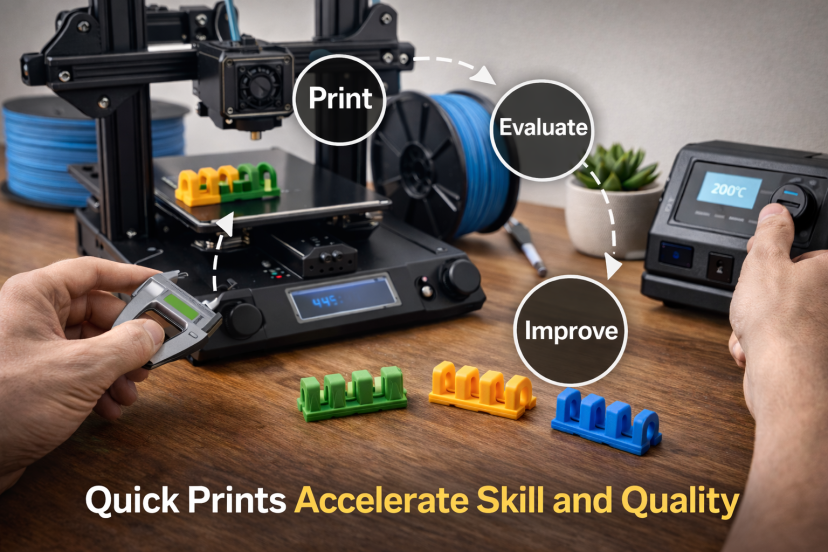
A recentcomprehensive review of additive manufacturing technologies explains that rapid prototyping dramatically shortens design cycles by allowing faster feedback between digital models and physical results. In simple terms, the quicker you print and evaluate a part, the faster you improve it. That’s exactly why short projects matter. When a cable clip finishes in 45 minutes, you can immediately test strength, tweak orientation, and reprint with better settings.
Additionally, asystematic review of FDM process parameters highlights how variables like layer height, nozzle temperature, print speed, and infill directly impact strength, surface quality, and dimensional accuracy. Instead of risking a 12-hour print to test new settings, small functional models let you experiment safely. Stringing becomes easier to catch. Temperature tweaks happen sooner. Infill settings improve with far less wasted filament.
Short, focused prints create tighter feedback loops. That loop builds technical understanding. And over time, those small adjustments lead to noticeably better prints.
So when you choose easy 3d printing ideas under two hours, you’re not cutting corners. You’re following the same rapid-iteration principles professionals use in engineering and product development.
Why Short Projects Improve Skill Faster
Long prints hide mistakes until the end. Short prints reveal them quickly.
For example:
- Warping? You’ll see it in 30 minutes.
- Stringing? You notice instantly.
- Adhesion issues? Fixable by the next attempt.
Because turnaround is fast, you iterate more often. Over time, your settings improve naturally.
This is how hobbyists evolve into confident makers.
Final Thoughts
3D printing doesn’t have to mean overnight projects and crossed fingers. In fact, some of the most satisfying progress comes from small, practical builds you can finish the same day. These easy 3d printing ideas prove that short prints still teach valuable skills and solve real problems. Start with one quick project, dial in your settings, and build from there. Momentum matters more than complexity—and every successful print moves you forward.
FAQs
1. What is the best filament for easy 3D printing ideas?
PLA works best for beginners. It prints at lower temperatures and sticks well to most build plates.
2. Can I really finish these prints in under two hours?
Yes. Most designs mentioned here average 30 to 90 minutes depending on layer height and infill.
3. Do I need advanced software to design these projects?
Not at all. Free tools like Tinkercad or Fusion’s basic version handle simple designs perfectly.
4. How can I reduce print failures on small objects?
Level your bed properly, use clean filament, and maintain consistent nozzle temperature.
5. Are easy 3D printing ideas good for selling?
Absolutely. Small, practical items like cable clips and keychains sell well locally and online.