Large Scale 3D Printer Models Built for Bigger Projects
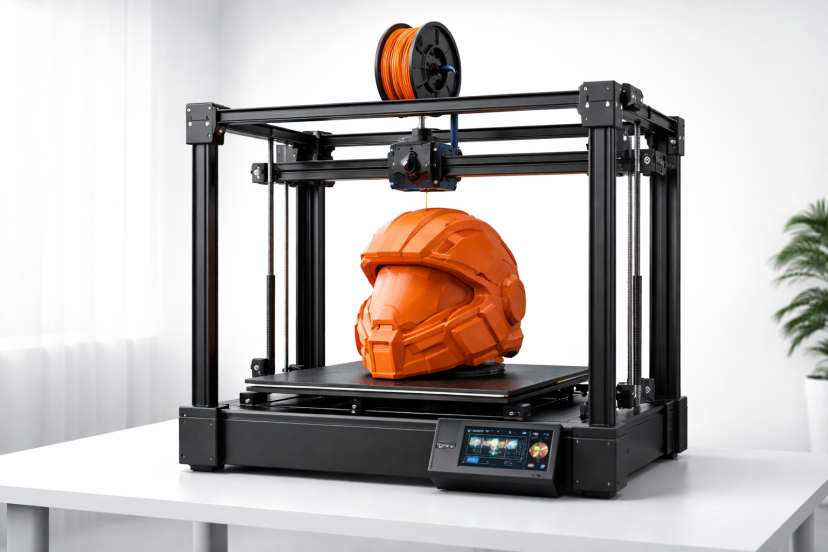
Printing large models on a standard machine usually means splitting files, gluing parts together, and spending extra time sanding seams. A large scale 3d printer solves that problem by giving you more build space for helmets, props, prototypes, and other oversized projects. In this article, you’ll see what makes a large-format printer worth buying, which features matter most, and which models are best suited for bigger jobs.
Why a Large Scale 3D Printer Is Worth Considering
A large printer is not just about size. It’s about efficiency.
For example, imagine printing a full helmet. On a smaller printer, that job might require four or five separate pieces. Each piece needs alignment, glue, filler, and sanding. With a large-format machine, the same project can often print in one pass. That single change can cut down your workload significantly.
Large printers also make sense for:
- Cosplay and prop making
- Furniture and home decor projects
- Large prototypes
- Batch production
- Functional parts
- Workshop tools and fixtures
Another big advantage is workflow. Instead of running multiple print cycles, you can print several items at once. That’s especially helpful if you sell prints or run a small printing business.
However, size only pays off if you truly need it. If you mostly print small items, a giant machine will sit underused. Bigger is powerful—but only when it matches your projects.
What Counts as a “Large Scale” 3D Printer
There isn’t a strict rule, but most people consider a printer “large scale” once the build volume reaches around 300 mm or more in at least one direction.
Here’s a quick way to think about it:
Standard size:
220 × 220 × 250 mm
Large format:
300 × 300 × 300 mm or bigger
Extra large:
400 mm to 500 mm build dimensions
Once you move into the 400 mm range, you can print items that simply aren’t practical on standard machines.
For example:
- Helmets
- Large planters
- Storage bins
- Props and costumes
- Architectural models
- Workshop equipment
That’s where large printers really shine.
What to Look For Before Buying a Large Scale 3D Printer
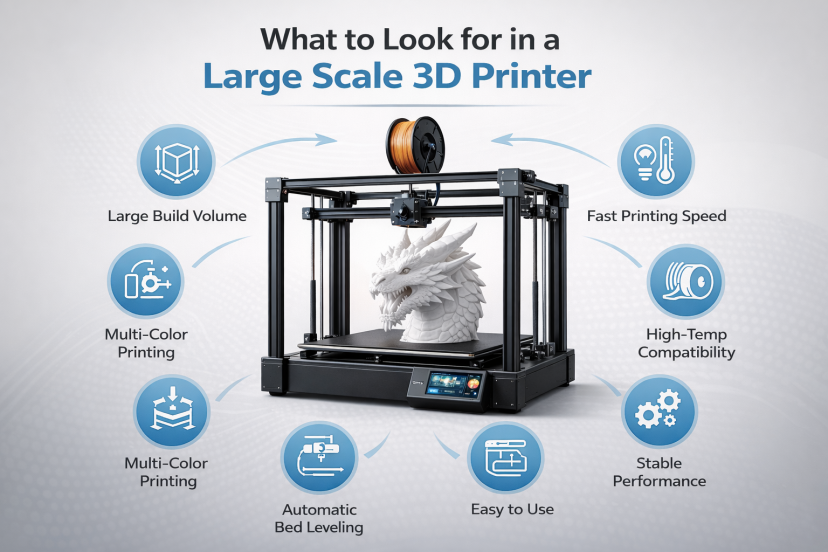
Buying a big printer is a commitment. So before you click the order button, pay attention to the features that actually affect real-world performance.
Build Volume
This is the headline feature, but it should match your needs.
Ask yourself:
- What is the largest object I plan to print?
- Do I want to print multiple items at once?
- Do I need tall prints?
Choosing the right size prevents overspending and wasted space.
Frame Stability
Large prints take time—sometimes many hours or even days. A weak frame can cause wobbling, which leads to visible layer lines or failed prints.
Look for:
- Metal frames
- Reinforced structures
- Solid bed support
Stability matters more than speed when prints get big.
Automatic Bed Leveling
Manual leveling on a large bed can be frustrating. Even tiny differences in height can cause print failures.
Automatic leveling systems save time and reduce stress. They are especially helpful on large machines.
Hotend Temperature
Each material needs its own temperature range to print properly.
Most large printers support:
- PLA
- PETG
- TPU
- ABS
Higher-end machines may also support:
- Nylon
- ASA
- Carbon fiber blends
If you plan to experiment with advanced materials, make sure the hotend can handle it.
Motion System
There are two main motion styles:
Bedslinger
The bed moves back and forth.
Common and affordable.
CoreXY
The print head moves while the bed stays mostly still.
Faster and more stable.
For very large prints, CoreXY systems often perform better. However, many bedslinger printers still deliver excellent results.
Multi-Color Capability
Large printers already unlock bigger designs. But color can take projects even further.
If you want to experiment with multi-material or multi-color printing, it helps to understand how those systems work. This guide on multi-color printing explains the process clearly and shows what to expect before you invest in upgrades.
Best Large Scale 3D Printer Models
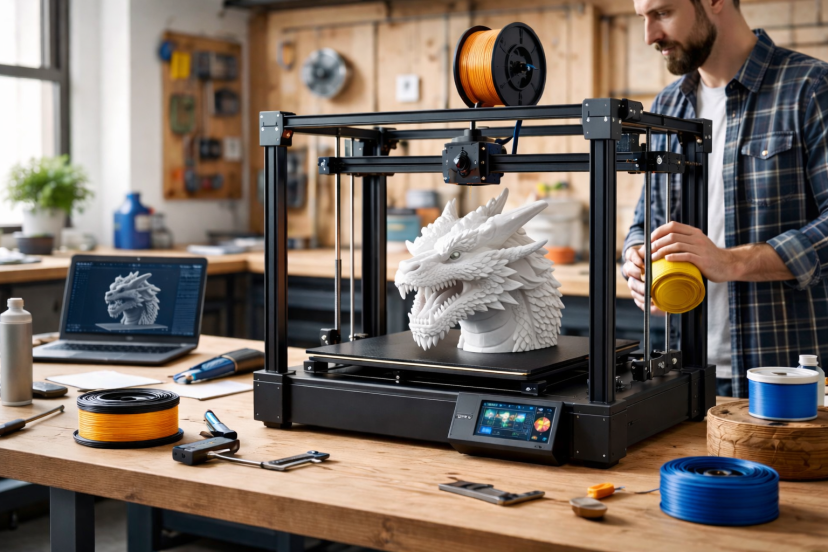
If you’re investing in a large scale 3d printer, the goal isn’t just size—it’s reliability, stability, and consistent performance on long prints. The models below cover different budgets and use cases, from serious production work to practical home workshops.
1) Creality K2 Plus Combo
If you want a machine that truly feels like a step into professional territory, this is the one I’d look at first. The Creality K2 Plus Combo 3D Printer brings a large 350 × 350 × 350 mm build volume together with modern features like multi-color printing and high-speed performance.
Why it stands out:
- Large build volume for full-size prints
- Multi-color printing capability
- Strong frame stability
- Fast printing speeds
- Excellent for production workflows
Best for: Cosplay makers, small businesses, engineering prototypes, and anyone printing large parts regularly.
2) Longer LK5 PRO
The Longer LK5 PRO FDM 3D Printer is one of those machines that keeps showing up in workshops because it simply works. It doesn’t try to be flashy, but it delivers dependable performance at a very approachable price point.
Why it stands out:
- Affordable entry into large-format printing
- Tall build capacity
- Simple setup
- Reliable daily performance
Best for: Beginners upgrading to a larger printer, home workshops, and hobbyists who want more size without overspending.
3) Flashforge AD5X
The Flashforge AD5X 3D Printer sits in a comfortable middle ground. It offers dependable performance, a sturdy structure, and smooth operation without overwhelming complexity.
Why it stands out:
- Stable printing performance
- Solid frame construction
- Easy-to-manage workflow
- Reliable for long prints
Best for: Makers who want dependable results and minimal troubleshooting.
4) Flashforge Adventurer 5M
The Flashforge Adventurer 5M 3D Printer focuses on speed, ease of use, and smart automation. It’s a modern machine that feels fast and responsive right out of the box.
Why it stands out:
- Fast printing speeds
- Automatic calibration features
- Clean user interface
- Reliable performance
Best for: Frequent printing, batch production, and users who value speed and simplicity.
5) ELEGOO Centauri Carbon
The ELEGOO Centauri Carbon 3D Printer is built for users who want to push beyond standard materials. It supports stronger filaments like carbon fiber blends, making it a great fit for functional parts and mechanical projects.
Why it stands out:
- Supports advanced materials
- Strong, enclosed design
- High precision printing
- Durable construction
Best for: Engineering parts, functional prototypes, and performance-focused printing.
Why Accuracy and Warping Matter More on Bigger Prints
A large scale 3d printer gives you more freedom, but it also makes small mistakes a lot more obvious. On a bigger machine, tiny calibration issues can turn into noticeable fit problems, rough seams, or parts that need more cleanup than expected. That lines up with a 2024 review on dimensional accuracy in FDM 3D printing, which found that print precision depends heavily on process control, repeatability, and settings like layer height, temperature, and other fabrication variables. The review also noted that FDM parts often still need post-processing, testing, or validation before they meet final-use standards.
Warping is another issue that gets harder to ignore as your prints get larger. A 2023 study on resolving warping in thermoplastic 3D prints explains that warping is a common problem caused by shrinkage during cooling. The researchers found that their heterostructure brim approach completely resolved warping in the parts they tested, and they also showed that surface area coverage, thickness, and part shape all affect how resistant a print is to warping. In simple terms, once you start printing bigger parts, bed adhesion, brim choice, and temperature control matter even more than most people expect.
That’s why choosing a large-format printer is only half the equation. The other half is making sure the machine can hold steady, stay consistent, and manage heat well over long print times. When you get those basics right, bigger prints stop feeling risky and start feeling a whole lot more practical.
Conclusion
A large scale 3d printer can completely change what you’re able to build. It removes size limits, speeds up production, and makes complex projects much easier to manage. Still, bigger machines demand more attention. They require careful setup, solid calibration, and realistic expectations. So think about what you print most often. If your projects keep pushing the limits of your current machine, upgrading to a large-format printer is one of the smartest moves you can make. Once you experience the freedom of printing bigger designs without splitting models into pieces, it’s hard to go back.
FAQs
How do you define a large-format 3D printer?
Most printers become “large scale” once the build volume reaches around 300 mm or more in at least one direction.
Are large 3D printers harder to use?
They can be slightly more complex, especially during setup. However, modern printers with automatic leveling make the process much easier.
What can I print with a large format 3D printer?
You can print helmets, props, planters, tools, furniture parts, and large prototypes without splitting models into sections.
Do large printers print faster?
Not necessarily. They can print larger objects, but speed depends on hardware, settings, and print quality.
Is a large scale 3D printer worth it for hobbyists?
Yes—if you regularly print large items or want to expand your projects. Otherwise, a standard printer may be more practical.