Top 10 3D Printer Accessories
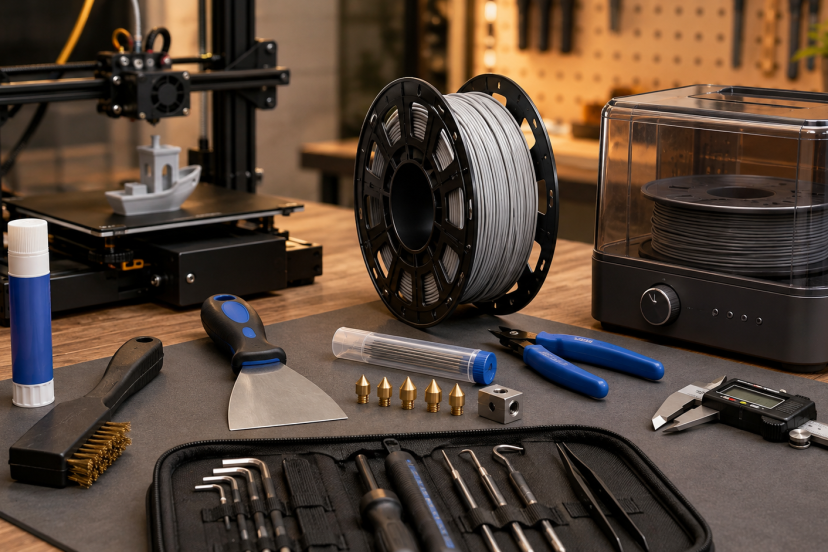
A printer alone is rarely enough for consistently clean, accurate results. The right 3D printer accessories help prevent wet filament, poor first layers, clogged nozzles, rough edges, and frustrating maintenance sessions. This guide focuses on practical upgrades that earn their place beside the printer. Before buying, check your printer’s build-plate dimensions, nozzle type, hotend design, and Bowden or direct-drive setup.
Our Top Picks
| Product | Best For | Key Feature | Rating | Read More |
| SUNLU FilaDryer S2 | Humid rooms | 70°C drying with circulation fan | ★★★★⯪ | Read more |
| Creality 74-Piece Tool Kit | All-in-one maintenance | Organized repair and finishing tools | ★★★★⯪ | Read more |
| NEIKO 01407A Digital Caliper | Dimensional checks | Inch, fraction, and millimeter modes | ★★★★⯪ | Read more |
| Magigoo Original | Bed adhesion | Grips hot and releases cool | ★★★★⯪ | Read more |
| Hakko CHP-170 | Clean filament cuts | Sharp angled micro jaws | ★★★★⯪ | Read more |
| AFA Tooling Deburring Tool | Smoothing edges | Swiveling HSS blade | ★★★★⯪ | Read more |
| Capricorn XS Bowden Tubing | Smoother filament feeding | Tight, low-friction filament path | ★★★★⯪ | Read more |
| Comgrow Printer Enclosure | Draft and dust control | Foldable enclosed workspace | ★★★★⯪ | Read more |
| Creality 235 × 235 mm PEI Plate | Easier print removal | Flexible magnetic spring steel | ★★★★⯪ | Read more |
| MIKA3D Nozzle Cleaning Kit | Clearing partial clogs | Needles, tweezers, and micro bits | ★★★★⯪ | Read more |
Top 10 3D Printer Accessories Reviewed
1. SUNLU FilaDryer S2

Best for: Makers dealing with humid air, PETG, TPU, nylon, or opened spools.
Key features: 70°C heat, circulation fan, humidity display, print-through feeding.
The S2 is the most useful upgrade here when moisture is causing popping, stringing, weak layers, or rough surfaces. It heats from 35°C to 70°C, uses a circulation fan, displays temperature and humidity, and lets filament feed directly to the printer. SUNLU lists compatibility with 1.75, 2.85, and 3.0 mm filament.
Pros: Simple controls; print-through design; broad material support.
Cons: Holds one standard spool; not a substitute for airtight long-term storage.
Why we recommend it: It fixes a common print-quality problem without modifying the printer.
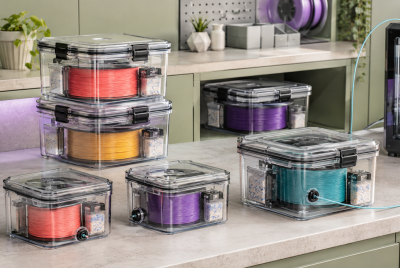
For storage between jobs, see this guide to keeping 3D printer filament dry.
2. Creality 74-Piece 3D Printer Tool Kit

Best for: Beginners building their first complete maintenance bench.
Key features: Cutters, files, wrenches, removal tools, nozzle-care pieces, storage wrap.
Creality’s large kit combines assembly tools, nozzle-care items, cutters, removal tools, files, and finishing accessories in an organized wrap. It is more convenient than buying every small tool separately, although experienced makers may eventually replace their most-used pieces with premium versions. The product has maintained strong marketplace feedback, but some buyers describe individual tools as light-duty.
Pros: Broad selection; portable storage; useful starter value.
Cons: Overkill for minimalists; quality varies by tool.
Why we recommend it: It covers most routine printer and post-processing jobs in one purchase.
3. NEIKO 01407A Digital Caliper

Best for: Checking part dimensions, holes, wall thickness, and calibration cubes.
Key features: Four-way measurement plus inch, fraction, and millimeter modes.
A digital caliper turns “that looks close” into measurable feedback. The stainless-steel NEIKO reads in inches, fractions, or millimeters and measures inside, outside, depth, and step dimensions. It is accurate enough for everyday printer calibration and has accumulated a very large volume of buyer feedback across major retailers.
Pros: Large display; multiple measurement modes; sturdy case.
Cons: Not a laboratory instrument; should be zeroed before important measurements.
Why we recommend it: Few accessories improve troubleshooting and design work this cheaply.
4. Magigoo Original Adhesive

Best for: Large footprints, warp-prone materials, and inconsistent first layers.
Key features: Controlled applicator, hot-bed grip, cool-bed release, water cleanup.
Magigoo Original applies neatly to glass, PEI, BuildTak, coated flex plates, and several other common surfaces. It is formulated to hold prints while the bed is hot and release them after cooling. The standard formula supports materials including PLA, ABS, PETG, HIPS, ASA, and TPU, and cleans with water.
Pros: Controlled applicator; easy cleanup; broad material compatibility.
Cons: Adds a recurring consumable; cannot correct poor leveling or a dirty plate.
Why we recommend it: It is cleaner and more predictable than improvised sprays.
5. Hakko CHP-170 Micro Cutter
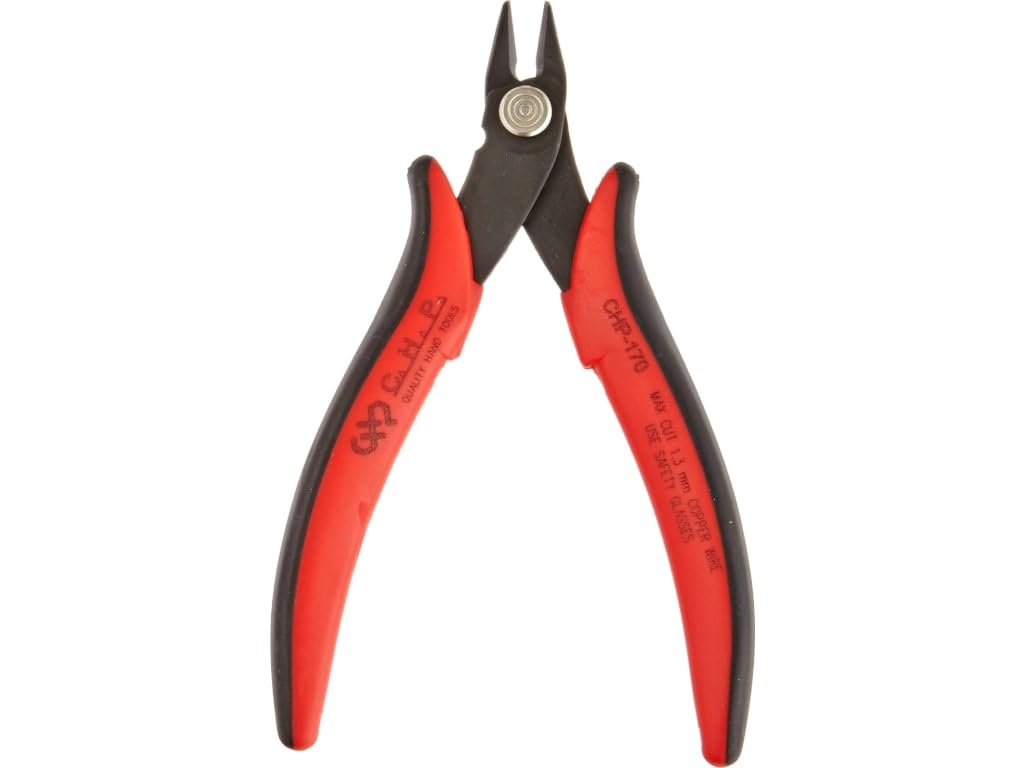
Best for: Trimming filament, supports, zip ties, and small plastic details.
Key features: Angled micro jaws, spring return, compact flush-cutting design.
The Hakko CHP-170 is a compact flush cutter with angled jaws that reach close to the workpiece. It makes cleaner filament cuts before loading and handles light support cleanup better than bulky household pliers. Its long-running Amazon feedback is unusually strong for such an inexpensive hand tool.
Pros: Sharp; lightweight; comfortable for repetitive cuts.
Cons: Intended for soft wire and plastic, not hardened metal.
Why we recommend it: This is the small tool most owners reach for every day.
6. AFA Tooling Deburring Tool

Best for: Removing brims and smoothing sharp circular or straight edges.
Key features: Swiveling high-speed-steel blade and replaceable cutting tips.
A swivel-blade deburring tool cleans edges faster than sanding alone, especially around holes and curved openings. This AFA Tooling set includes a handle and replaceable high-speed-steel blades. Use light pressure because aggressive passes can gouge thin walls or remove intentional details.
Pros: Fast edge cleanup; replaceable blades; comfortable grip.
Cons: Requires practice; exposed blades need careful storage.
Why we recommend it: It produces a more finished look with very little effort.
7. Capricorn XS Bowden Tubing

Best for: Bowden printers with inconsistent feeding or worn stock tubing.
Key features: Tight filament path, low-friction tube, fittings, square-cutting tool.
Genuine Capricorn XS tubing provides a tighter filament path than many basic factory tubes, which can reduce unwanted movement between the extruder and hotend. Kits commonly include pneumatic fittings and a square-cutting tool. Compatibility matters: direct-drive printers may not need it, and PTFE should never be treated as a substitute for an all-metal hotend at demanding temperatures.
Pros: Smooth feeding; useful fittings; proven upgrade for many Ender-style machines.
Cons: Printer-specific benefit; counterfeit or mislabeled tubing exists.
Why we recommend it: It is a focused upgrade with a noticeable mechanical purpose.
8. 3D Printer Enclosure

Best for: Open-frame printers exposed to drafts, dust, pets, or fluctuating room temperatures.
Key features: Foldable frame, zippered access, viewing window, enclosed print space.
The foldable enclosure creates a more stable space around compatible desktop printers and helps keep debris away when the machine is idle. It is especially useful for materials sensitive to cool drafts. Measure the printer at its widest moving points before ordering, and do not treat any soft enclosure as permission to leave a printer unattended.
Pros: Quick setup; folds for storage; front viewing window.
Cons: Takes substantial desk space; electronics may need heat-management consideration.
Why we recommend it: It offers an accessible enclosure option without a custom build.
9. Creality 235 × 235 mm PEI Build Plate

Best for: Compatible Ender, K1, and similarly sized printers needing easier part removal.
Key features: Magnetic spring steel, PEI surface, flexible print release.
A flexible PEI-coated spring-steel plate can simplify both adhesion and removal. Print on the correctly prepared surface, let the plate cool, and then flex it gently. This Creality size fits many—but not all—220 mm-class machines, so model compatibility must be checked carefully. Current product data identifies a magnetic 235 × 235 mm format and broad filament support.
Pros: Fast part release; reusable surface; clean workflow.
Cons: Wrong dimensions or locating tabs can prevent fit; PEI still needs proper cleaning.
Why we recommend it: It is one of the most noticeable quality-of-life upgrades for compatible printers.
Good hardware still needs correct setup. Follow these 3D printer bed-leveling tips before blaming the plate.
10. MIKA3D Nozzle Cleaning Kit

Best for: Clearing partial clogs and maintaining common FDM nozzles.
Key features: Cleaning needles, precision tweezers, and micro drill bits.
The MIKA3D kit combines fine cleaning needles, tweezers, and micro drill bits for targeted nozzle care. Always heat the hotend appropriately, unload the filament first, and use tools that match the nozzle opening. Forcing an oversized needle into the nozzle can damage its carefully shaped orifice.
Pros: Compact; inexpensive; several cleaning methods in one case.
Cons: Tiny tools are easy to lose; severe clogs may require a cold pull or replacement nozzle.
Why we recommend it: It handles a common failure without adding another bulky toolkit.
Final Thoughts
The best 3D printer accessories are not the flashiest ones—they are the tools that prevent wasted filament, shorten maintenance, and make successful prints repeatable. The SUNLU S2 is the strongest overall pick for moisture-related problems, while the NEIKO caliper, Hakko cutter, and MIKA3D cleaning kit form a practical everyday toolkit. Check compatibility before buying upgrades, then add 3D printer accessories one problem at a time rather than filling the bench with gear you may never use.
FAQs
What accessories do I need for a 3D printer?
Most beginners need flush cutters, a scraper or flexible plate, tweezers, a digital caliper, nozzle-cleaning tools, and dry filament storage. A dryer, adhesive, enclosure, or replacement tubing becomes useful when a specific print problem appears.
Is a filament dryer worth buying?
Yes, especially in humid climates or when printing with PETG, TPU, nylon, polycarbonate, and other moisture-sensitive materials. Drying can reduce popping, stringing, rough surfaces, and weak layer bonding, but dried spools should still be stored in sealed containers.
Do I need glue on a PEI build plate?
Not always. Clean, correctly leveled PEI often holds PLA without extra adhesive. Glue can help with warp-prone prints and may act as a release layer for materials that bond too aggressively. Follow the plate and filament manufacturer’s guidance.
How often should a 3D printer nozzle be cleaned?
Clean the outside when residue accumulates and investigate the inside when extrusion becomes uneven, under-extrusion appears, or filament curls unexpectedly. Avoid routinely inserting needles into a working nozzle because unnecessary probing can cause damage.
Which 3D Printer Accessories should I buy first?
Choose the tool that solves your most frequent failure. For a new setup with no obvious problem, start with quality flush cutters and a digital caliper. Makers in humid areas may get more immediate value from a filament dryer or airtight storage.