5 Practical 3D Printed Kitchen Gadgets
Ever wish your kitchen tools actually fit the way you cook? With 3D printing, you can make small, practical gadgets designed for your exact space and daily habits. From custom drawer dividers to bag clips, spice organizers, and sink-side holders, these simple prints can solve everyday kitchen problems without adding more clutter. In this guide, we’ll look at useful 3D printed kitchen gadgets, how to use them safely, which materials work best, and the products that can help you print cleaner, stronger kitchen accessories.
Why 3D Printed Kitchen Gadgets Are So Useful
The kitchen is full of tiny annoyances. Cabinet shelves sit too far apart. Utensils roll around. Measuring spoons vanish into the void. Store-bought organizers almost fit, but not quite. That “almost” is exactly why 3D printing works so well in the kitchen.
You can design or download gadgets that fit your space, your tools, and your habits. For example, you can print a narrow spice organizer for a small apartment kitchen, a custom pod holder for your coffee station, or a drawer insert sized around your favorite utensils.
Another big benefit is replacement. If a small plastic part breaks on a kitchen tool, you may not need to replace the whole item. Sometimes, a simple printed replacement part can save money and reduce waste.
Still, the smartest approach is to print practical helpers instead of trying to replace every kitchen tool. Use 3D printing for organization, dry handling, storage support, spacing, labeling, and convenience.
Are 3D Printed Kitchen Gadgets Food-Safe?
This is the part many beginners skip, but it matters.
Most home 3D printers create objects layer by layer. Those tiny layer lines can leave small grooves where moisture, crumbs, and bacteria may collect. Formlabs notes that FDM printing creates narrow crevices between layers, and long-term food-safe use requires a smoother surface and often a suitable food-safe coating.
So, does that mean you should never use 3D printed items in the kitchen? Not at all. It just means you should match the gadget to the right job.
A drawer divider does not touch food. A spice jar rack holds containers, not spices. A sponge holder touches water and cleaning tools, so it needs better material choice and regular cleaning. A cookie cutter or spoon should be treated more carefully because it touches food directly.
For food-contact items, material choice alone does not solve everything. The FDA explains that it approves food additives and certain substances used in materials that contact food, but “FDA approved” claims can be misunderstood when applied loosely to finished consumer products.
A good rule: use 3D printed kitchen tools mainly for storage, organization, and dry contact unless you fully understand the material, coating, cleaning method, and intended use.
5 Useful 3D Printed Kitchen Gadgets for Beginners
1. Measuring Spoon Holder
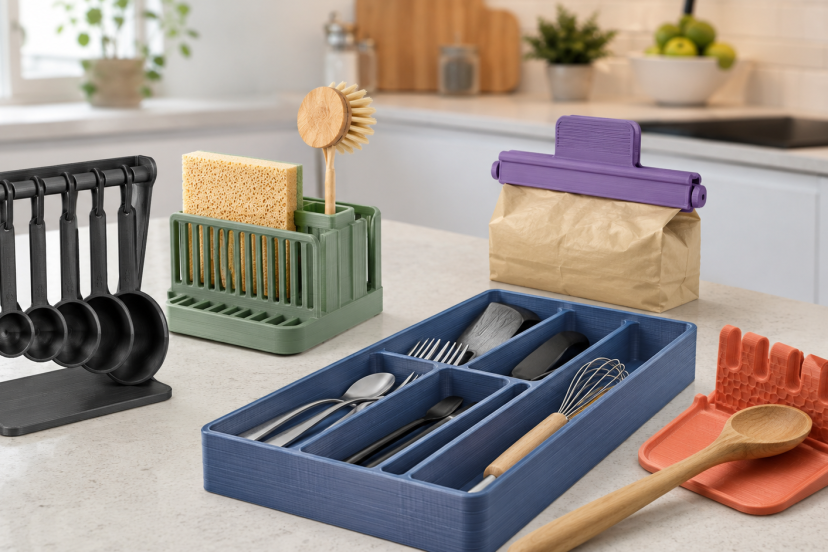
A measuring spoon holder is a simple print you will appreciate every time you bake. Instead of tossing spoons into a messy drawer, you can hang them on a cabinet door, mount them near your baking station, or place them inside a drawer insert.
It is also a low-risk kitchen print because it does not touch food. It only holds the handles. For dry areas, PLA works well, while PETG is better if your kitchen gets humid.
2. Bag Clip With Pour Spout
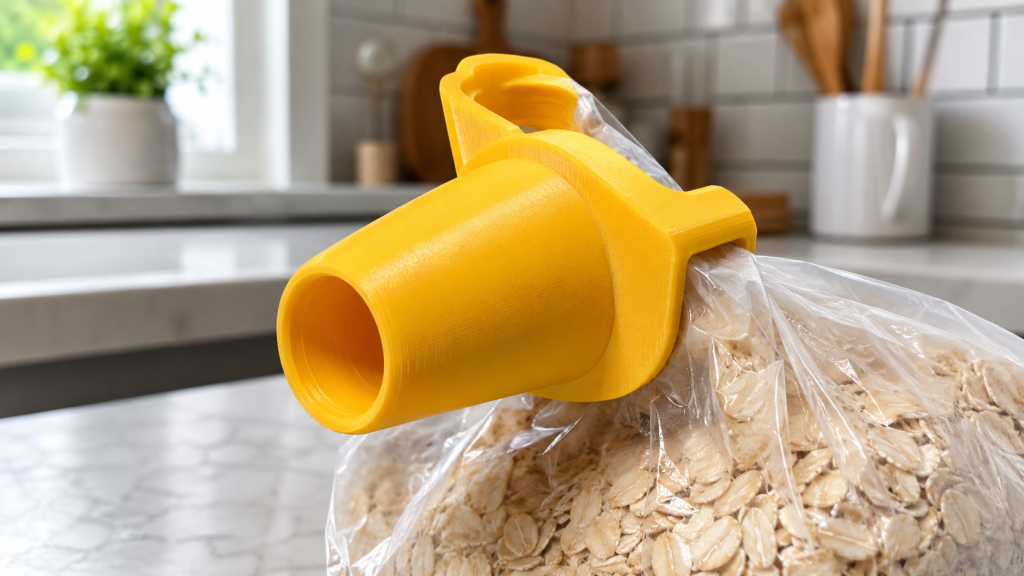
A bag clip with a pour spout is great for rice, oats, cereal, coffee beans, flour, pet food, and snacks. It seals the bag and makes pouring cleaner, so you do not have to open the whole package every time.
Use this gadget mostly for dry goods. Avoid wet, oily, or sticky foods, especially if the print has rough layer lines. PETG is a smart choice because it is tougher than basic PLA. Also, print thicker walls so the clip does not crack after a few uses.
3. Drawer Divider System
A custom drawer divider may be one of the most useful 3D printed kitchen gadgets. Store-bought dividers often waste space because they come in fixed sizes. With 3D printing, you can create dividers that fit your exact drawer.
You can print sections for knives, measuring spoons, peelers, spatulas, chopsticks, bag clips, and baking tools. Better yet, print one piece at a time and adjust the layout as your kitchen needs change.
Before printing, measure the drawer’s width, depth, and height. Then leave a little clearance so the pieces slide in easily.
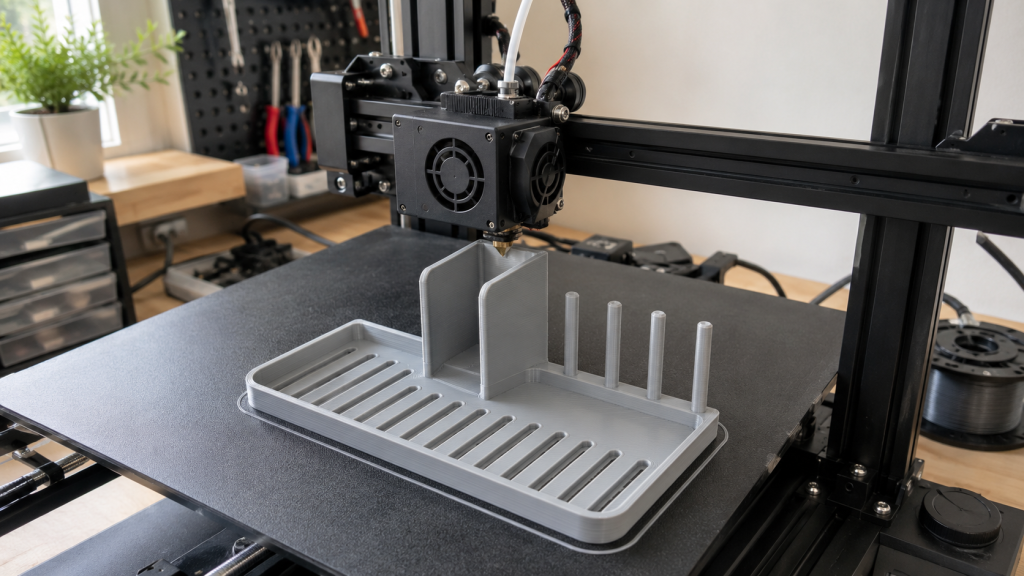
4. Sponge and Brush Drying Rack
A sponge or brush drying rack keeps wet tools off the counter and helps them dry faster. That means less mess and fewer musty smells near the sink.
For this print, drainage is key. Add holes, raised feet, or a slanted base so water does not sit at the bottom. Since this gadget stays near moisture, PETG is usually better than PLA.
Clean it often. If it starts to smell, crack, or collect grime in the layer lines, reprint it. Small functional prints are easy to replace.
5. Custom Spice Jar Organizer
A custom spice jar organizer keeps your spices neat and easy to find. It also helps you avoid buying duplicates because nothing gets lost behind the cinnamon again.
You can print a tiered rack, drawer insert, wall rail, or rotating organizer. Choose the design based on how you cook. If you grab spices near the stove, a wall rail may work best. If you prefer clear counters, a drawer insert is a cleaner option.
Since this print only holds jars, it does not touch food directly. That makes it a safe and practical beginner project.
Best Materials for 3D Printed Kitchen Gadgets
The best material depends on how you plan to use the gadget.
PLA is easy to print and works well for dry organizers, drawer dividers, labels, and holders. However, it does not handle heat well, so keep it away from dishwashers, hot pans, sunny windows, and steam.
PETG is better for functional kitchen prints. It is tougher than PLA and handles moisture better, making it useful for clips, racks, and sink-side items.
ABS can handle more heat, but it gives off stronger fumes while printing and needs better ventilation. For most home kitchen projects, PETG is the easier choice.
Resin prints can look smooth, but standard SLA resins are not food-safe by default. Use them carefully and avoid direct food contact unless the resin is clearly rated for that purpose.
Top Products for 3D Printing Kitchen Gadgets
Here are five helpful products for making stronger, cleaner, and more practical 3D printed kitchen gadgets.
1. OVERTURE PETG 1.75mm Filament
A strong filament for drawer dividers, clips, sponge holders, and spice organizers. PETG is tougher than basic PLA and works well for functional kitchen prints.
2. eSUN PETG 1.75mm Filament
Another reliable PETG option for bag clips, racks, holders, and storage accessories. It is a good pick for prints that need durability.
3. 3D Printer Nozzle Cleaning Kit
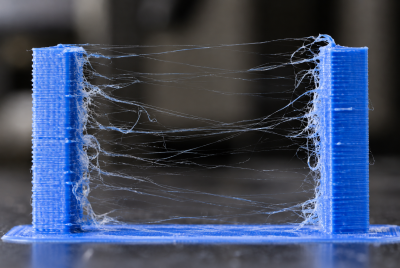
A cleaning kit helps prevent clogs, stringing, and rough prints. For extra help, read this guide on how to clean a 3D printer nozzle.
4. Digital Caliper
A digital caliper helps you measure drawers, jars, and cabinet spaces accurately. It is useful for custom-fit organizers and spice racks.
5. MAX CLR Food-Safe Epoxy Coating
This coating can help smooth certain short-contact kitchen prints. Always follow the curing and use instructions before using coated prints near food.
How to Keep 3D Printed Kitchen Gadgets Clean
Cleaning is important because 3D printed parts often have tiny layer lines where moisture, crumbs, and bacteria can collect. That does not mean you should avoid 3d printed kitchen gadgets, but it does mean you should use and wash them wisely.
A study on sanitizing 3D-printed parts for food and medical use found that common FFF materials like PLA/PLA+ and PETG can be cleaned effectively with warm water around 120°F and regular dish soap.
For everyday use, hand wash printed gadgets with warm, soapy water, scrub small grooves gently, and let them dry fully before storing. Also, avoid dishwashers unless the material can handle heat. If a printed tool cracks, smells, or develops rough spots, reprint it instead of trying to keep using it.
Conclusion
3D printed kitchen gadgets are worth making when they solve real problems, fit your space, and stay within safe use limits. Start with low-risk prints like drawer dividers, measuring spoon holders, spice organizers, bag clips, and drying racks. Choose PETG for tougher kitchen utility prints, keep food-contact safety in mind, and maintain your printer so every gadget comes out clean and strong. Once you get the hang of it, your kitchen starts feeling less like a cluttered drawer museum and more like a space designed around how you actually cook.
FAQs
Are 3D printed kitchen gadgets safe to use?
Yes, many are safe when used for organization, dry storage, and non-food-contact purposes. Be more careful with items that touch food directly. Use suitable materials, smooth surfaces, safe coatings when needed, and regular cleaning.
What is the best filament for 3D printed kitchen gadgets?
PETG is often a strong choice for functional kitchen prints because it handles moisture and everyday use better than basic PLA. PLA still works well for dry drawer organizers, labels, and holders.
Can I put 3D printed kitchen gadgets in the dishwasher?
Usually, no. Many common filaments can warp or soften in dishwasher heat. Hand wash printed kitchen gadgets unless the material, coating, and manufacturer guidance clearly support dishwasher use.
Which 3D printed kitchen tools are best to start with?
Start with a measuring spoon holder, drawer divider, bag clip, spice jar organizer, or sponge rack. These prints are practical, simple, and less risky than direct food-contact tools.
Should 3D printed items touch food?
They can in some cases, but direct food contact needs extra care. For most home users, it is smarter to use 3D printed gadgets for organizing, holding containers, dry handling, or short-term use rather than long-term food contact.