Top 10 Filament Storage Containers
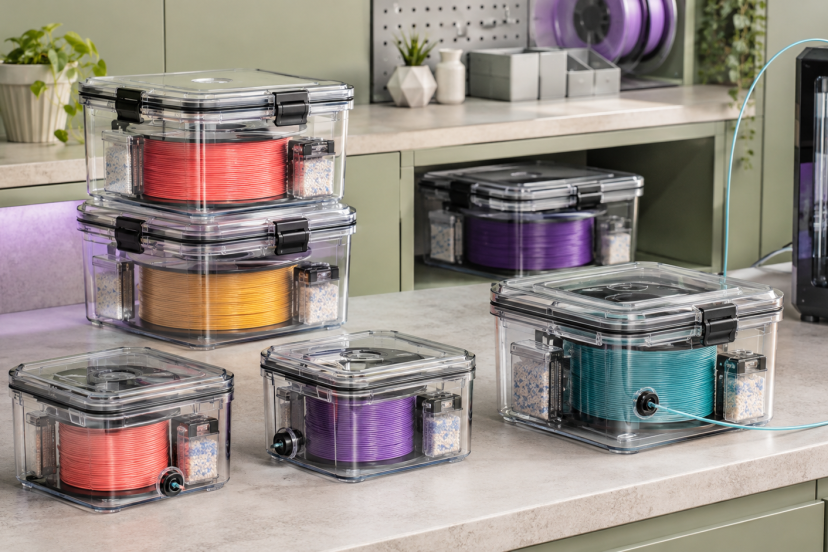
Moisture can turn a perfectly good spool into a source of popping, stringing, weak layers, and rough surfaces. The best filament storage containers help prevent those problems by protecting your PLA, PETG, TPU, nylon, and other materials between prints.
This guide covers everything from affordable vacuum bags to heated four-spool dry boxes. Whether you own three spools or an entire filament collection, you’ll find an option that matches your printing habits, available space, and preferred level of humidity control.
Our Top Picks
| Product | Best For | Key Feature | Rating | Read More |
| Polymaker PolyDryer Box | Best overall | Modular drying and storage system | ★★★★⯪ | Read more |
| eSUN Vacuum Storage Kit | Best value | Reusable vacuum-sealed bags | ★★★★⯪ | Read more |
| Creality Space Pi Plus | Dual-spool printing | Two-spool heated chamber | ★★★★⯪ | Read more |
| SUNLU Filadryer S4 | Large collections | Holds four standard spools | ★★★★⯪ | Read more |
| Sovol SH01 | Budget dual-spool drying | Built-in fan with temperature and humidity display | ★★★★☆ | Read more |
| Creality Space Pi X4 | Engineering filament | Maximum temperature up to 85°C | ★★★★⯪ | Read more |
| YOOPAI Vacuum Bag Kit | Compact storage | Space-saving sealed bags | ★★★★⯪ | Read more |
| AMOLEN Vacuum Storage Kit | Occasional printing | Simple manual vacuum system | ★★★★⯪ | Read more |
| Comgrow SH02 | Two-printer setups | Dual-spool capacity | ★★★★⯪ | Read more |
| Qozary Filament Storage Boxes | Large filament collections | Four containers hold about 24 standard spools | ★★★★⯪ | Read more |
Best Filament Storage Containers Reviewed
1. Polymaker PolyDryer Box
Best for: Most 3D printing enthusiasts
Rating: ★★★★⯪

The Polymaker PolyDryer stands out because it separates active drying from long-term storage. Its reusable storage box connects to the PolyDryer base when a spool needs drying, then remains sealed after you remove it.
This modular design makes sense for anyone who regularly switches materials. You can maintain several protected spools without buying a heating base for every container. The box also allows direct filament feeding, so moisture-sensitive materials can remain enclosed while printing.
Key features:
- Modular drying and storage design
- Built-in hygrometer
- Direct-printing filament outlet
- Replaceable desiccant compartment
- Fits common 1kg spools
Pros:
- Excellent moisture protection
- Storage boxes stack neatly
- Heating base can serve multiple boxes
- Suitable for hygroscopic filament
Cons:
- Additional boxes increase the total cost
- Dryer base may be sold separately
Why we recommend it: It offers one of the most practical combinations of active drying, sealed storage, and direct printing.
2. eSUN Filament Vacuum Storage Kit
Best for: Affordable storage for several spools
Rating: ★★★★⯪

The eSUN kit provides reusable vacuum bags, sealing clips, desiccant, and a compact hand pump. Each spool can be sealed separately, which prevents frequently used filament from exposing the rest of your collection to humid air.
Vacuum bags also require much less shelf space than rigid containers. The tradeoff is convenience: resealing a bag takes longer than placing a spool inside a hinged dry box.
Key features:
- Reusable vacuum bags
- Manual air-removal pump
- Moisture-indicator cards
- Desiccant packs
- Individual spool protection
Pros:
- Economical for growing collections
- Easy to store in drawers or cabinets
- Clear bags make filament identification simple
- No electricity required
Cons:
- Valves and seals require careful handling
- Bags may eventually wear out
Why we recommend it: With strong customer feedback and a straightforward design, this is an accessible way to protect many spools without buying multiple hard containers.
3. Creality Space Pi Filament Dryer Plus
Best for: Drying and printing from two spools
Rating: ★★★★⯪

The Creality Space Pi Plus holds two 1kg spools and uses circulated heat to remove absorbed moisture. Its touchscreen includes presets for common materials, reducing the guesswork involved in selecting drying temperatures.
Four filament outlets make it adaptable to different printer positions. You can also feed two printers or a multi-material setup while keeping both spools protected.
Key features:
- Two-spool capacity
- 360-degree heated-air circulation
- Material temperature presets
- Touchscreen controls
- Multiple PTFE tube outlets
Pros:
- Convenient controls
- Dries and stores simultaneously
- Supports common filament diameters
- Useful for dual-printer workstations
Cons:
- Larger than a single-spool dryer
- Not intended for storing an entire collection
Why we recommend it: It is a capable everyday solution for users who want active drying without moving filament into another container afterward.
4. SUNLU Filadryer S4
Best for: High-volume printing
Rating: ★★★★⯪

The SUNLU S4 accommodates four standard spools, making it particularly useful for print farms, multicolor projects, and users with several printers. Its PTC heating system circulates warm air throughout the enclosure rather than heating only from below.
Automatic humidity management helps maintain a controlled environment after the main drying cycle. However, its capacity and heater make it substantially larger than a basic dry box.
Key features:
- Four-spool capacity
- Circulating PTC heating
- Automatic humidity-control mode
- Multiple filament feed ports
- Material-based drying settings
Pros:
- Handles several active spools
- Good for multi-material workflows
- Even heat distribution
- Can feed filament during printing
Cons:
- Requires considerable desk space
- Excessive for users with only a few spools
Why we recommend it: Few desktop containers offer this combination of capacity, active drying, and direct feeding.
5. Sovol SH01 Filament Dryer
Best for: Budget-friendly dual-spool drying
Rating: ★★★★☆

The Sovol SH01 can accommodate two filament rolls under 70mm wide or one oversized roll under 150mm wide. Its built-in fan distributes warm air around the chamber, helping dry filament more evenly.
The display monitors temperature and humidity in real time. Users can select temperatures of 40°C, 45°C, or 50°C and set a drying time between six and 12 hours. Silicone and PTFE seals also help protect stored filament when the dryer is switched off.
Key features:
- Holds two narrow spools or one wide spool
- Built-in fan for even heating
- Real-time temperature and humidity display
- Three temperature settings
- Six-to-12-hour timer
Pros:
- Dries two compatible spools at once
- Supports direct printing from the box
- Monitors internal storage conditions
- Can store filament without power
Cons:
- Maximum temperature is limited to 50°C
- Desiccant packs are not included
Why we recommend it: The Sovol SH01 combines active drying, sealed storage, and dual-spool capacity in a compact design. It is a practical option for makers who regularly print with PLA, PETG, TPU, and ABS.
6. Creality Space Pi X4
Best for: Nylon, polycarbonate, and composite filament
Rating: ★★★★⯪

The Space Pi X4 is designed for users who print with more demanding materials. Its dual-chamber configuration holds four spools and reaches temperatures up to 85°C, according to the manufacturer.
Higher heat can be important for drying nylon and similar hygroscopic materials effectively. PLA users may not need this capability, but it gives advanced makers more room to expand.
Key features:
- Four-spool capacity
- Maximum temperature up to 85°C
- Two independently controlled chambers
- Active air circulation
- Wide material compatibility
Pros:
- Appropriate for engineering materials
- Separate chamber settings
- High-capacity design
- Prints directly from the enclosure
Cons:
- Large footprint
- Premium features may be unnecessary for PLA
Why we recommend it: It is one of the stronger choices for workshops that routinely use nylon, PC, PA-CF, and other moisture-sensitive materials.
7. YOOPAI Filament Vacuum Storage Kit
Best for: Small workshops with limited shelf space
Rating: ★★★★⯪

YOOPAI’s kit follows the individual-bag approach, giving each spool its own sealed environment. It is a sensible choice for colors or specialty materials you use only occasionally.
The transparent bags simplify spool identification, while included humidity indicators help you determine when desiccant needs attention. As with all vacuum bags, inspect the valve and seal before putting a spool away for months.
Key features:
- Reusable spool-sized bags
- Hand vacuum pump
- Sealing clips
- Humidity indicators
- Desiccant included
Pros:
- Compact and portable
- Protects spools individually
- More affordable than heated boxes
- Easy to expand
Cons:
- Does not dry already-wet filament
- Manual resealing takes time
Why we recommend it: It delivers practical, inexpensive protection for filaments that do not need to stay connected to a printer.
8. AMOLEN Filament Vacuum Storage Kit
Best for: Occasional makers
Rating: ★★★★⯪
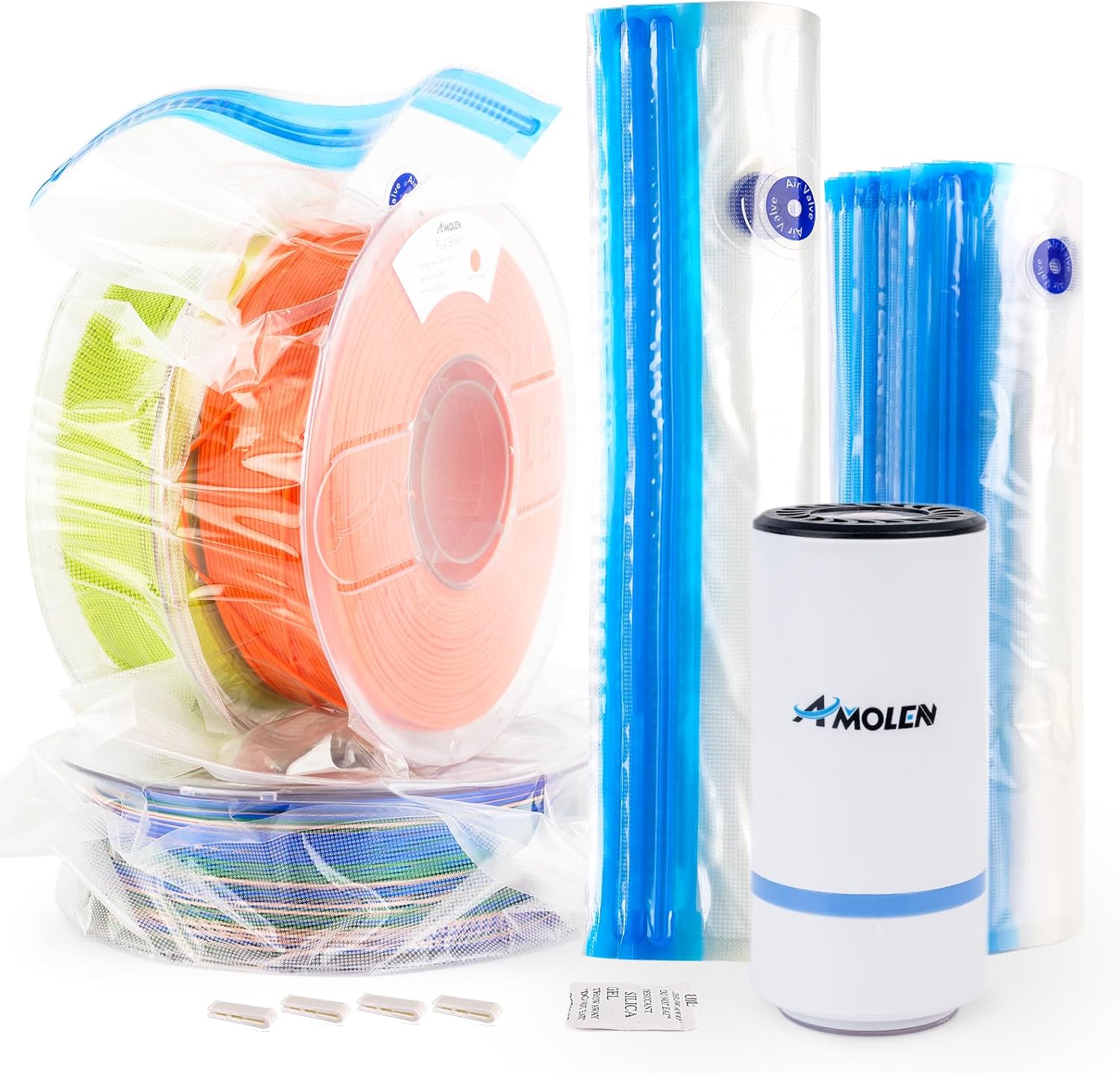
AMOLEN’s vacuum kit offers a straightforward way to protect open spools without adding powered equipment to your workspace. It typically bundles reusable bags with a pump and humidity-control accessories.
It works particularly well for decorative colors and specialty filaments that may sit unused for weeks. Just remember that removing air prevents new moisture exposure—it cannot extract moisture already absorbed inside the filament.
Key features:
- Reusable vacuum bags
- Compact hand pump
- Airtight double-seal design
- Moisture indicators
- Desiccant packs
Pros:
- Simple storage system
- Requires little space
- Good for infrequently used colors
- No power consumption
Cons:
- Bag seals must remain clean
- Not a replacement for active drying
Why we recommend it: This is an uncomplicated starter option for makers who want better protection than the original filament bag provides.
9. Comgrow SH02 Filament Dryer Box
Best for: Two-printer workstations
Rating: ★★★★⯪

The Comgrow SH02 holds two 1kg rolls and uses a PTC heater with circulated airflow. Its outlets accommodate different printer and extruder positions, helping avoid sharp filament bends.
This model is especially useful when PETG or TPU remains loaded for extended jobs. It occupies less space than four-spool systems while still serving two printers.
Key features:
- Two-spool enclosure
- PTC heater
- Circulating warm air
- Adjustable temperature
- Multiple feed positions
Pros:
- Balanced size and capacity
- Can serve two printers
- Direct printing supported
- Suitable for common filament types
Cons:
- Takes longer to access spools than an open holder
- Controls are less refined than some premium models
Why we recommend it: The SH02 offers useful dual-spool capacity without committing desk space to a four-roll machine.
10. Qozary Filament Storage Boxes
Best for: Large filament collections
Rating: ★★★★⯪

The Qozary set includes four storage containers with enough combined room for approximately 24 standard 1kg spools. Separate boxes make it easy to organize filament by color, material, or printing frequency.
Each container uses water-repellent fabric and a fully zippered lid to protect spools from dust, splashes, and ambient humidity. Desiccant packs are included to help maintain a dry environment, although these boxes cannot actively dry filament that has already absorbed moisture.
Key features:
- Four separate storage boxes
- Holds approximately 24 standard spools
- Water-repellent 600D Oxford fabric
- Zippered lids and included desiccant
- Foldable, tool-free design
Pros:
- Generous storage capacity
- Makes sorting filament easier
- Folds flat when not in use
- Fits on shelves and under workbenches
Cons:
- Not completely airtight
- No active heating or humidity display
Why we recommend it: The Qozary set provides convenient bulk storage for makers with numerous filament colors and materials. Its foldable design, included desiccant, and separate compartments make it a practical alternative to one oversized container.
How to Choose Filament Storage Containers
Start by deciding whether you need to keep dry filament dry or rescue filament that has already absorbed moisture. Airtight boxes and vacuum bags handle prevention, while heated dryers can actively remove moisture.
Consider these factors:
- Capacity: A single-spool box is compact, but multi-spool units work better for print farms and multicolor systems.
- Seal quality: Look for gaskets, strong valves, or dependable zipper seals.
- Humidity monitoring: A hygrometer helps reveal when desiccant needs recharging.
- Direct feeding: Filament outlets let moisture-sensitive material remain protected throughout a print.
- Temperature range: Nylon and polycarbonate generally need more heat than PLA.
- Spool dimensions: Check internal measurements if you use oversized or 3kg spools.
For a deeper explanation of desiccants, humidity targets, and storage routines, read this guide to keeping 3D printer filament dry. Dry material can also support more consistent extrusion when dialing in your 3D printer layer-height settings.
Final Thoughts
The best filament storage containers match the size of your collection and the materials you actually print. The Polymaker PolyDryer is the strongest all-around choice for modular storage, while the eSUN kit offers excellent value for protecting many individual spools. If you run several printers or use moisture-sensitive engineering materials, a heated multi-spool system such as the SUNLU S4 or Creality Space Pi X4 provides the capacity and temperature control needed for more consistent results.
Frequently Asked Questions
What is the best way to store 3D printer filament?
Place filament in airtight filament storage containers or vacuum bag with fresh desiccant. Store it away from sunlight and large temperature changes, and use a hygrometer to monitor humidity when possible.
Do filament storage containers dry wet filament?
Passive filament storage containers prevent further moisture absorption but do not reliably remove moisture already trapped inside filament. A heated filament dryer is the better option for restoring a wet spool.
Can I store PLA without an airtight container?
PLA is less moisture-sensitive than nylon, but it can still absorb water over time. Airtight storage is worthwhile, particularly in humid climates or when a spool remains unused for several weeks.
What humidity level is best for filament storage?
A relative humidity below approximately 20% inside the container is a practical target for most materials. Highly hygroscopic filaments benefit from consistently dry storage and may still require periodic heated drying.
Are vacuum bags better than filament dry boxes?
Vacuum bags are affordable, compact, and ideal for inactive spools. Dry boxes are more convenient for frequently used filament because they can provide humidity monitoring, direct feeding, and—on powered models—active drying.