Carbon Fiber Filament: Everything You Need to Know
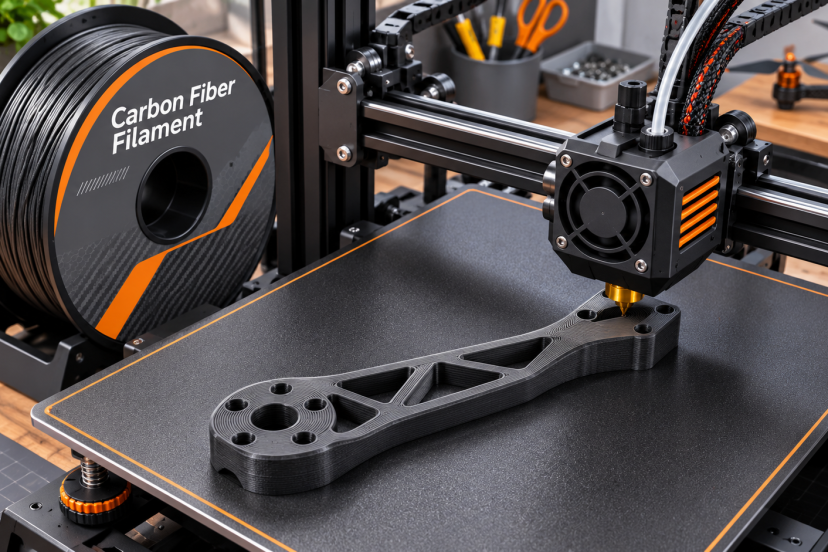
Carbon fiber filament has become popular with makers who want 3D-printed parts that look cleaner, feel stiffer, and perform better than ordinary plastic in certain jobs. It is commonly used for brackets, jigs, drone parts, tool holders, enclosures, and functional prototypes.
Still, the name can be misleading. Most desktop carbon fiber filament is not a continuous strand of carbon fiber. It typically combines a base plastic such as PLA, PETG, nylon, or polycarbonate with small pieces of carbon fiber. That combination changes how the material prints and behaves, but it does not automatically make every part stronger.
If you want to try it, the key is choosing the right base polymer and preparing your printer for an abrasive material.
What Is Carbon Fiber Filament?
Carbon fiber filament combines a plastic-based material with tiny carbon fiber particles to create a stiffer 3D printing filament. The plastic remains the main material, while the fibers can change stiffness, dimensional stability, surface texture, and heat performance.
That distinction matters because PLA-CF, PETG-CF, nylon-CF, and PC-CF behave differently. A carbon-filled PLA may be easy to print but still soften at temperatures that would not trouble a nylon or polycarbonate blend.
A 2024 study on carbon-fiber-reinforced PLA found that carbon fiber could improve stiffness and overall mechanical performance, but the outcome depended on fiber content and settings such as layer height, bed temperature, speed, and nozzle temperature.
How Is It Different From Regular Filament?
The first difference you may notice is the finish. Carbon-filled materials often create a dark, matte surface that hides layer lines and gives functional parts a refined appearance.
The second is stiffness. Short carbon fibers can make a part more resistant to bending, which helps with fixtures, mounts, frames, and other components that should hold their shape.
However, stiffness is not the same as toughness. Composite materials can be more brittle, and layer-to-layer bonding may be weaker than with the unfilled polymer. Prusa notes that filled materials can improve dimensional stability while reducing impact resistance and interlayer adhesion in some cases.
Common Types of Carbon Fiber Filament
PLA-CF
PLA-CF is usually the easiest starting point. It has low warping, modest temperature requirements, and a clean matte finish. It works well for housings, jigs, fixtures, and rigid prototypes, but it is not ideal for high-heat environments.
PETG-CF
PETG-CF balances printability and durability. It is generally tougher than PLA-CF while remaining easier to manage than nylon or polycarbonate. It suits workshop parts, equipment mounts, electronics housings, and medium-duty functional components.
Nylon-CF
Nylon-CF is aimed at more demanding mechanical work. It can offer excellent stiffness, wear resistance, and heat performance for gears, brackets, tooling, and robotic components.
Its biggest challenge is moisture. Nylon absorbs water readily, so drying and sealed storage matter.
PC-CF
Polycarbonate carbon fiber blends target stiff, heat-resistant parts such as fixtures, machine components, and structural prototypes. They can require a high-temperature hotend, enclosure, suitable bed surface, and careful drying.
For specific material options, see this comparison of carbon fiber filaments.
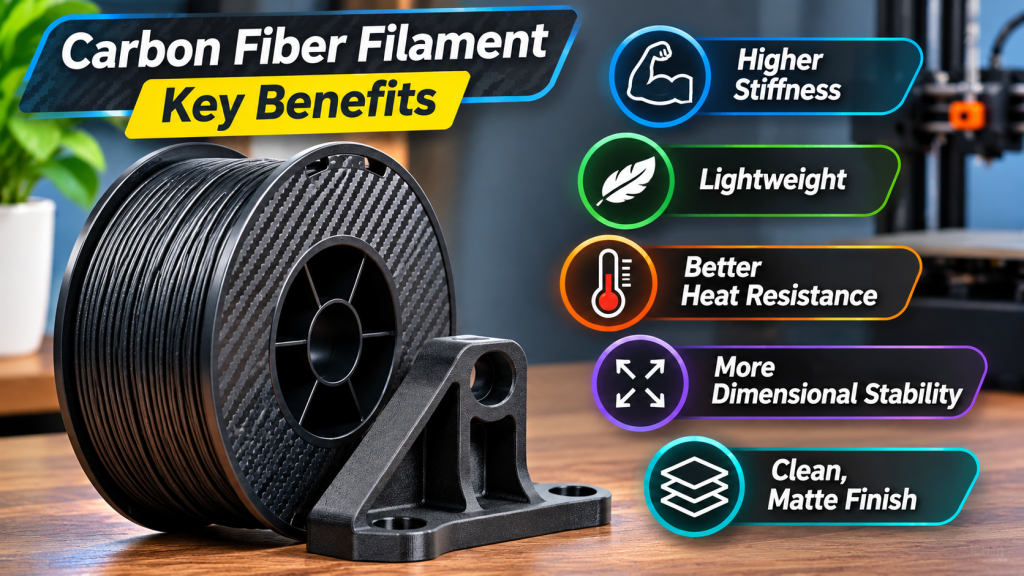
Benefits of Carbon Fiber Filament
One of the main advantages is dimensional stability. Carbon-filled materials often shrink and warp less than their unfilled counterparts, which can help when printing larger functional parts.
They can also produce stiff components without much extra weight. That is useful for drones, camera rigs, RC parts, fixtures, and lightweight brackets.
The matte, textured surface is another bonus. It tends to hide small print imperfections and can make parts look more professional straight off the build plate.
What Are the Downsides?
The biggest issue is abrasion. Because carbon fibers are highly abrasive, they can wear down ordinary brass nozzles much faster than standard filament. As the nozzle opening grows, extrusion becomes less predictable and dimensional accuracy can suffer.
For better durability, use a nozzle made from hardened steel, tungsten carbide, ruby-tipped material, or another abrasion-resistant option. Prusa’s guide to carbon-filled composite materials specifically recommends a hardened nozzle for carbon-, glass-, and Kevlar-filled filaments.
Clogging can also occur because chopped fibers must pass through the nozzle. A 0.4 mm nozzle works with many products, but a 0.6 mm nozzle often gives the fibers more room and reduces clogging risk.
Carbon fiber filament also costs more than ordinary PLA or PETG, so it makes the most sense when you need its stiffness, stability, heat performance, or finish.
Printer Requirements and Setup
At minimum, your printer needs an abrasion-resistant nozzle. Nylon-CF and PC-CF may also require an all-metal hotend, enclosure, higher bed temperatures, and a filament dryer.
Start with the filament manufacturer’s profile whenever possible. Fiber percentage and polymer formulations vary between brands, so settings that work for one spool may fail with another.
Print speed also affects results. Slowing down can help when troubleshooting extrusion or layer bonding, although modern high-flow printers may run much faster. This guide to finding a good 3D printing speed explains how speed, flow, cooling, and layer height work together.
Tips for Better Carbon Fiber Prints
Dry the spool when the manufacturer recommends it, especially with PETG-CF, nylon-CF, or PC-CF. Popping sounds, rough surfaces, stringing, and inconsistent extrusion can point to moisture.
Keep the nozzle clean and purge thoroughly when switching materials. A partial blockage can turn into a stubborn clog once chopped fibers enter the hotend.
For functional parts, think carefully about orientation. FDM parts are often weakest between layers, so position the model so the main load does not depend entirely on interlayer adhesion.
Also, do not assume that more carbon fiber means a better part. A 2025 study found that increasing PLA-CF content improved tensile performance in its test setup but reduced flexural performance, showing the tradeoff between stiffness and flexibility.
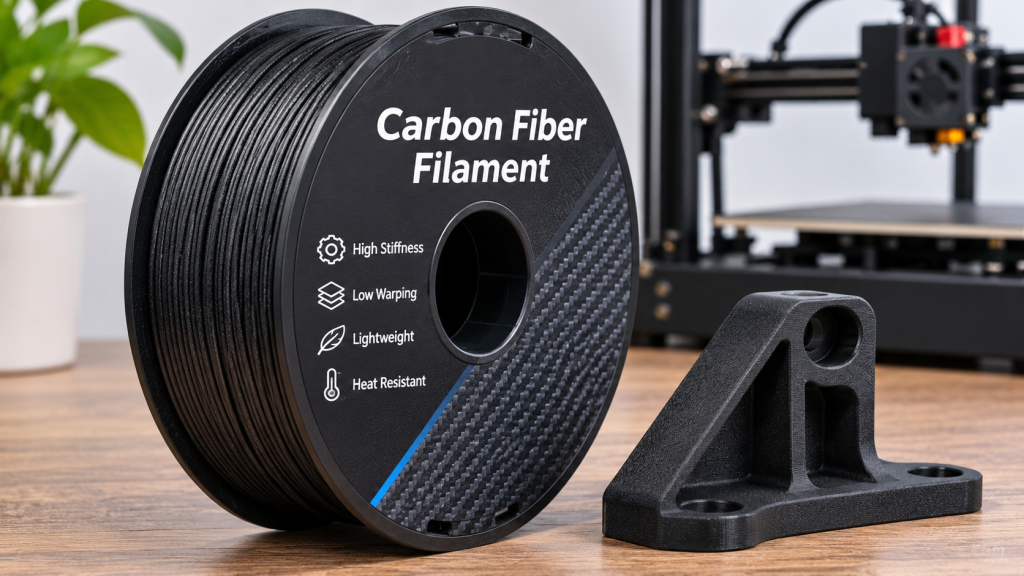
Recommended Products
1. ELEGOO PLA-CF – A practical choice for beginners who want extra rigidity and a matte carbon-fiber finish without moving straight to engineering materials.
2. Creality Hyper PLA-CF – A PLA-based option aimed at modern high-speed printers and rapid prototyping.
3. ELEGOO PETG-CF – A useful middle ground for functional parts that need more toughness than PLA-CF while remaining approachable for hobby machines.
4. Polymaker Fiberon PA6-CF20 – A nylon 6 carbon-fiber composite intended for demanding mechanical parts. It is better suited to experienced users with drying equipment and capable hardware.
5. PRILINE Carbon Fiber Polycarbonate – A PC-CF option for stiff, heat-resistant functional parts that can be printed on higher-temperature setups.
Conclusion
Carbon fiber filament is a worthwhile upgrade when you need rigid, dimensionally stable parts with a clean matte finish. The important part is choosing the right base polymer rather than treating every carbon-filled spool as the same.
PLA-CF is the easiest starting point, PETG-CF offers a useful balance for everyday functional work, and nylon-CF or PC-CF fit more demanding mechanical or high-temperature projects. Whatever you choose, use a wear-resistant nozzle, follow the manufacturer’s drying guidance, and test your settings before starting a long print.
FAQs
Is carbon fiber filament stronger than regular filament?
Sometimes, but “stronger” is too broad. Carbon fiber often increases stiffness and dimensional stability, while impact resistance or layer adhesion may decrease depending on the blend and settings.
Is a wear-resistant nozzle necessary for carbon fiber filament?
Yes. A wear-resistant nozzle is recommended because the carbon fibers can gradually damage softer brass nozzles. Hardened steel or another abrasion-resistant material is a better choice.
Can an Ender 3 print carbon fiber filament?
Many Ender 3 models can print PLA-CF after adding a wear-resistant nozzle. Nylon-CF or PC-CF may require hotend, enclosure, and temperature upgrades.
Should you dry carbon fiber filament before printing?
Many blends benefit from drying, and nylon-CF usually needs it most. Check the filament maker’s instructions for the recommended drying temperature and duration.
Which nozzle size works best for carbon fiber filament?
A 0.4 mm nozzle can work with some brands, but a 0.6 mm nozzle generally lowers clogging risk and is often a better fit for chopped-fiber materials.