Top 10 3D Printer Nozzles
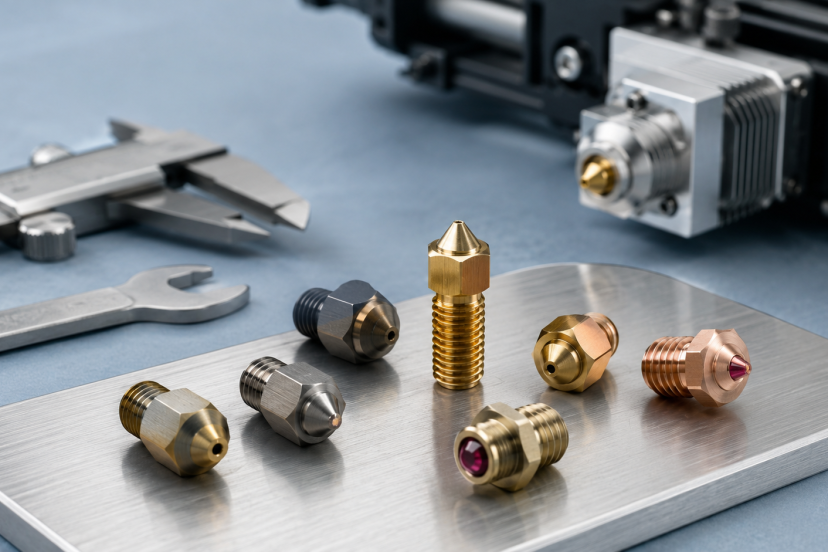
A nozzle may be one of the smallest components on your machine, but it has a huge effect on print quality, speed, and material compatibility. The best 3D printer nozzles deliver consistent extrusion while matching your hotend, filament, and preferred layer height.
This guide covers dependable brass nozzles for everyday PLA, hardened options for carbon-fiber filament, and high-flow designs for faster printing. Compatibility matters more than marketing, so check the thread type, overall length, and hotend requirements before ordering.
Our Top Picks
| Product | Best For | Key Feature | Rating | Read More |
| Micro Swiss CM2 MK8 | Best overall | Wear-resistant M2 steel insert | ★★★★⯪ | Read more |
| Genuine E3D V6 Brass | Everyday printing | Reliable thermal performance | ★★★★⯪ | Read more |
| Micro Swiss A2 Tool Steel | Abrasive filament | Hardened, plated construction | ★★★★⯪ | Read more |
| Bondtech CHT BiMetal MK8 | High-speed printing | Multi-channel melt path | ★★★★☆ | Read more |
| DiamondBack MK8 | Premium durability | Solid polycrystalline diamond tip | ★★★★⯪ | Read more |
| LUTER 24-Piece MK8 Set | Experimenting with sizes | Seven nozzle diameters | ★★★★☆ | Read more |
| Micro Swiss CM2 V6 | V6 hotends | Abrasion resistance and good flow | ★★★★⯪ | Read more |
| Micro Swiss FlowTech DiamondBack | FlowTech users | Diamond tip and cold swapping | ★★★★⯪ | Read more |
| Comgrow 24-Piece MK8 Set | Replacement supply | Multiple brass nozzle sizes | ★★★★⯪ | Read more |
| Bondtech CHT Coated Brass | Non-abrasive high-flow work | Faster internal melting | ★★★★⯪ | Read more |
Top 10 3D Printer Nozzles Reviewed
1. Micro Swiss CM2 MK8 Nozzle
Best for: A versatile, long-lasting upgrade
Rating: ★★★★⯪

The Micro Swiss CM2 MK8 is our best overall choice because it handles ordinary materials and demanding composites without forcing you to maintain separate nozzles. Its heat-treated M2 high-speed steel insert reaches a claimed hardness of 68 HRC.
Electroless nickel plating and a low-friction WS2 coating help filament move through the nozzle while reducing plastic buildup. It is suitable for PLA, PETG, ABS, TPU, glow-in-the-dark blends, and carbon- or glass-fiber-filled materials.
Key features:
- M2 hardened steel insert
- Nickel-plated, low-friction surface
- Compatible with many MK8-style hotends
- Designed for standard and abrasive filaments
Pros:
- Excellent all-material versatility
- Longer-lasting than standard brass
- Made by an established hotend manufacturer
Cons:
- Costs considerably more than brass
- Compatibility must be checked carefully
Why we recommend it: It offers a practical middle ground between inexpensive hardened steel and costly diamond-tipped designs.
2. Genuine E3D V6 Brass Nozzle
Best for: PLA, PETG, ABS, and other non-abrasive materials
Rating: ★★★★⯪

Genuine E3D brass nozzles remain a dependable choice for V6, Lite6, and Titan Aero hotends. Brass transfers heat efficiently, helping the hotend maintain stable extrusion without requiring a large temperature adjustment.
The familiar 0.4 mm version balances print time, strength, and detail. Smaller and larger diameters are also available for miniatures, prototypes, and wide-layer functional parts.
Key features:
- Precision-machined brass
- Multiple orifice sizes
- Strong thermal conductivity
- Genuine E3D construction
Pros:
- Predictable everyday performance
- Broad choice of nozzle diameters
- Good surface quality with standard filament
Cons:
- Abrasive additives wear brass quickly
- Not an MK8 nozzle despite the similar M6 thread
Why we recommend it: This is a safe, uncomplicated replacement for users running a compatible V6 hotend.
3. Micro Swiss A2 Tool Steel MK8 Nozzle
Best for: Carbon-fiber, wood-filled, and metal-filled filament
Rating: ★★★★⯪

This Micro Swiss nozzle uses heat-treated A2 tool steel and a TwinClad XT coating to resist abrasion. It fits many classic Creality Ender and CR-10 machines, along with other printers equipped with compatible MK8 hotends.
Steel conducts heat less efficiently than brass, so some printers may need a modest temperature increase. Once tuned, it is a durable upgrade for makers who regularly use composite filament.
Key features:
- A2 tool steel construction
- Wear-resistant plated finish
- 0.4 mm opening
- Wide MK8 compatibility
Pros:
- Proven option for abrasive materials
- More affordable than premium diamond nozzles
- Resists wear better than brass
Cons:
- May require temperature tuning
- Less versatile than CM2 construction
Why we recommend it: It provides dependable abrasion resistance without moving into the highest price tier.
4. Bondtech CHT BiMetal MK8 Nozzle
Best for: Faster printing with standard or abrasive filament
Rating: ★★★★☆

Bondtech’s CHT design divides incoming filament into several channels, allowing heat to reach the material from within. Faster melting can support a higher volumetric flow rate than a conventional nozzle, provided the rest of the printer can keep up.
The BiMetal version combines a conductive copper body with hardened vanadium-steel inserts. That construction makes it more suitable for abrasive filament than the regular coated-brass model.
Key features:
- Multi-channel CHT geometry
- Copper and vanadium-steel construction
- Nickel-plated exterior
- MK8 configuration
Pros:
- Supports high-flow printing
- Handles abrasive composites
- Useful for large, time-consuming parts
Cons:
- Requires slicer flow-rate tuning
- Internal channels complicate cold pulls
Why we recommend it: It tackles both melt capacity and wear, two common limits when printing composites quickly.
5. DiamondBack MK8 Nozzle
Best for: Premium, long-term abrasion resistance
Rating: ★★★★⯪

Rather than applying a thin diamond-like coating, DiamondBack uses a solid polycrystalline diamond tip. The material combines exceptional wear resistance with high thermal conductivity and a low-friction surface.
It is particularly appealing to workshops that print carbon-fiber, glass-fiber, glow, or metal-filled filament frequently. Casual PLA users will probably struggle to justify the investment.
Key features:
- Solid polycrystalline diamond tip
- Compatible with MK8-style systems
- High thermal conductivity
- Suitable for abrasive and standard filament
Pros:
- Outstanding wear resistance
- Minimal material buildup at the tip
- Can reduce frequent nozzle changes
Cons:
- Expensive
- Installation torque requirements matter
Why we recommend it: For heavy abrasive-filament use, its longevity can make more sense than repeatedly replacing lower-cost nozzles.
6. LUTER 24-Piece MK8 Nozzle Set
Best for: Testing different nozzle diameters
Rating: ★★★★☆

The LUTER set contains 24 brass MK8 nozzles covering sizes from 0.2 to 1.0 mm. You receive twelve 0.4 mm replacements plus smaller and larger options for testing detail, strength, and printing speed.
These are economical consumables rather than lifetime upgrades. They work best with non-abrasive materials such as standard PLA, ABS, and PETG.
Key features:
- Seven nozzle diameters
- Twelve standard 0.4 mm nozzles
- Labeled sizes
- Storage case included
Pros:
- Excellent variety for the cost
- Convenient supply of replacements
- Good for learning how diameter affects prints
Cons:
- Brass wears with composite filament
- Machining may be less consistent than premium nozzles
Why we recommend it: Beginners can explore nozzle sizes without buying each diameter individually.
7. Micro Swiss CM2 V6 Nozzle
Best for: V6 users who print multiple material types
Rating: ★★★★⯪

The V6 version of the Micro Swiss CM2 brings its hardened M2 insert, nickel plating, and low-friction coating to compatible RepRap-style hotends. It is a strong alternative to swapping between brass and hardened nozzles whenever your filament changes.
It can print ordinary thermoplastics as well as carbon-, glass-, and metal-filled composites. Confirm the nozzle dimensions because an M6 thread alone does not guarantee a proper hotend seal.
Pros:
- Handles standard and abrasive materials
- Good wear resistance
- Suitable for many V6 systems
Cons:
- Premium price
- Not interchangeable with every M6 nozzle
Why we recommend it: It is the V6 counterpart to our top overall MK8 pick.
8. Micro Swiss FlowTech DiamondBack Nozzle
Best for: FlowTech owners printing abrasive filament
Rating: ★★★★⯪

This model combines DiamondBack’s polycrystalline diamond tip with the quick-change Micro Swiss FlowTech format. The system permits cold nozzle changes on compatible FlowTech hotends and uses a sealed design intended to prevent leakage.
Compatibility is deliberately narrow, so this is not a universal screw-in upgrade. Select the version made for your exact FlowTech-equipped printer.
Pros:
- Exceptional abrasion resistance
- Convenient cold nozzle changes
- Good thermal performance
Cons:
- Requires a compatible FlowTech hotend
- High purchase cost
Why we recommend it: It gives dedicated FlowTech users premium durability without sacrificing the system’s easy swapping.
9. Comgrow 24-Piece MK8 Nozzle Set
Best for: Keeping inexpensive spare nozzles available
Rating: ★★★★⯪

Comgrow’s multipack is a useful maintenance-box addition for owners of compatible Ender and CR-10 printers. It provides assorted brass diameters, allowing you to replace a damaged nozzle or change the balance between detail and speed.
Because these are brass nozzles, reserve them for non-abrasive materials. A hardened nozzle remains the safer option for glow, carbon fiber, glass fiber, or metal-filled blends.
Pros:
- Useful assortment of sizes
- Affordable replacement supply
- Familiar brand among Creality users
Cons:
- Unsuitable for sustained abrasive printing
- Compatibility is not universal across newer Creality models
Why we recommend it: It is a sensible workshop pack for owners of traditional MK8 machines.
10. Bondtech CHT Coated Brass Nozzle
Best for: High-flow PLA, PETG, ABS, and TPU printing
Rating: ★★★★⯪

The original coated-brass Bondtech CHT nozzle offers efficient melting without the cost of the BiMetal version. Its divided filament path can increase flow capacity, making it useful for larger nozzles, wide extrusion lines, and speed-focused profiles.
Brass provides strong heat transfer but remains vulnerable to abrasive additives. Choose the BiMetal CHT if carbon- or glass-fiber composites are part of your routine.
Pros:
- Strong high-flow potential
- Better heat transfer than steel
- Multiple diameters available
Cons:
- Not intended for abrasive materials
- More difficult to clear than a conventional bore
Why we recommend it: It is a focused upgrade for experienced users whose standard nozzle is limiting print speed.
How to Choose the Right 3D Printer Nozzles
Start with compatibility. MK8, V6, Volcano, Nextruder, Revo, Unicorn, and proprietary quick-change 3D printer nozzles can share a thread diameter while differing in length, sealing surface, or internal construction.
Then match the material to your printing habits:
- Brass: Best for ordinary PLA, PETG, ABS, and TPU
- Hardened steel: Better for carbon fiber, glow, wood, and metal-filled blends
- Bi-metal: Balances heat transfer and wear resistance
- Diamond-tipped: Premium choice for intensive abrasive-material use
- High-flow: Helpful when melt capacity limits printing speed
A 0.4 mm opening remains the most versatile starting point. A 0.2 or 0.25 mm nozzle can capture finer details, while 0.6 and 0.8 mm sizes shorten print times and produce wider, stronger extrusion lines.
Changing diameter also requires a new slicer profile. Our guide to 3D printer layer-height settings explains how nozzle size and layer height work together.
Nozzle Installation and Maintenance Tips
Heat-tighten conventional 3D printer nozzles according to the hotend manufacturer’s procedure, taking care not to twist heater or thermistor wires. Quick-change systems may have completely different instructions, including hand tightening while cold.
If extrusion becomes inconsistent, inspect the filament path before assuming the nozzle is worn. The steps in this 3D printer nozzle cleaning guide can help address buildup and partial clogs safely.
Final Thoughts
The best 3D printer nozzles match both the hotend and the material you actually print. The Micro Swiss CM2 MK8 is our most versatile recommendation, while Genuine E3D brass is ideal for dependable everyday extrusion. Choose a Bondtech CHT when flow is the limiting factor, or invest in DiamondBack if abrasive filament is part of your regular workload. Above all, verify compatibility before buying—an excellent nozzle cannot perform properly if it does not seal against your hotend’s heat break.
FAQs
What is the best nozzle size for a 3D printer?
A 0.4 mm nozzle is best for most users because it balances detail, print speed, strength, and reliability. Smaller sizes favor detail, while larger nozzles work well for fast prototypes and sturdy functional parts.
Do hardened steel nozzles improve print quality?
Not automatically. Their main benefit is abrasion resistance. They may require a slightly higher printing temperature because steel transfers heat less efficiently than brass.
How often should a 3D printer nozzle be replaced?
Replace 3D printer nozzles when you notice an enlarged or irregular opening, inconsistent extrusion, declining dimensional accuracy, or unexplained surface defects. Brass can wear quickly with abrasive filament, while hardened and diamond-tipped nozzles generally last longer.
Can I use carbon-fiber filament with a brass nozzle?
It may print initially, but carbon fiber can enlarge a brass opening surprisingly quickly. Use hardened steel, vanadium steel, tungsten carbide, or a diamond-tipped nozzle for regular composite printing.
Are all M6 3D printer nozzles interchangeable?
No. Two nozzles can have M6 threads but differ in threaded length, tip geometry, overall length, and sealing position. Always match the nozzle to the hotend model rather than relying on the thread size alone.