Top 10 3D Scanners
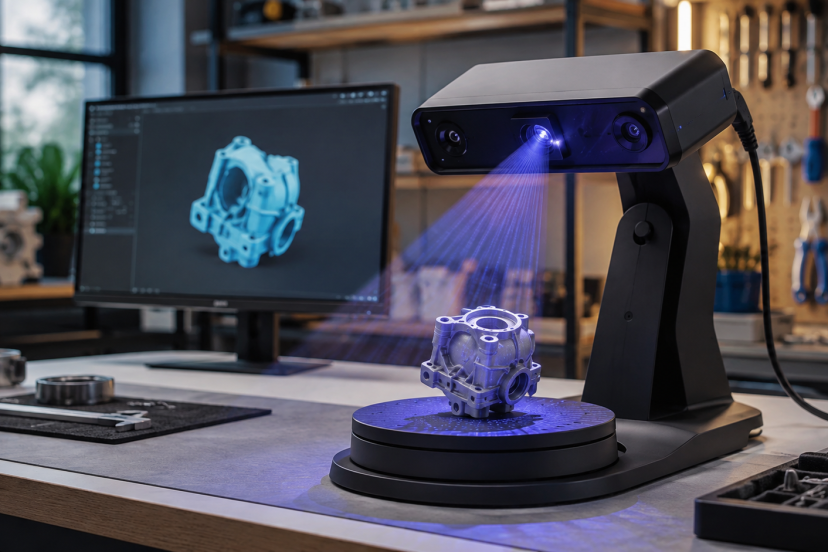
A good 3D scanner can turn an existing object into an editable digital model without forcing you to recreate every curve by hand. That makes 3D scanners useful for replacement parts, product prototypes, automotive components, sculptures, cosplay props, body scans, and digital archives.
The hard part is choosing the right scanner. Some models excel at tiny mechanical details, while others are better for people, furniture, vehicle panels, or large objects. This guide compares ten Amazon options across different budgets and use cases so you can choose a scanner that fits the work you actually plan to do.
Our Top Picks
| Product | Best For | Key Feature | Rating | Details |
| Revopoint POP 3 Plus | Best overall value | Optical zoom and full-color scanning | ★★★★⯪ | Read more |
| Creality CR-Scan Raptor | Fine mechanical details | Blue laser and infrared modes | ★★★★⯪ | Read more |
| Creality CR-Scan Otter | Mixed object sizes | Four-lens stereo system | ★★★★★ | Read more |
| Creality Ferret Pro | Budget wireless scanning | Wi-Fi mobile connectivity | ★★★★★ | Read more |
| Revopoint MetroY | Industrial modeling | Multi-line blue laser scanning | ★★★★★ | Read more |
| Revopoint INSPIRE 2 | Portable scan-to-print projects | Laser and structured-light scanning | ★★★★☆ | Read more |
| Creality Sermoon P1 | Standalone professional use | Built-in computing and display | ★★★★★ | Read more |
| EINSTAR 2 | Wireless field scanning | Blue laser and infrared scanning | ★★★★☆ | Read more |
| CR-Ferret SE | Beginners and classrooms | Simple full-color scanning | ★★★★★ | Read more |
| Revopoint MetroX Pro | Precision reverse engineering | Four industrial scanning modes | ★★★★☆ | Read more |
Top 10 3D Scanners Reviewed
1. Revopoint POP 3 Plus: Best Overall Value

The Revopoint POP 3 Plus offers a practical balance of portability, detail, color capture, and manageable pricing. Its reported precision reaches 0.04 mm, while optical zoom helps capture more surface detail on medium-size parts.
It is a strong choice for makers scanning tools, decorative models, product shells, brackets, and objects they plan to modify before printing. The compact design also works with Windows, macOS, Android, and iOS devices. Amazon-linked rating data showed an 8.8/10 score from 79 ratings during research.
Key features: Optical zoom, full-color capture, wireless support, multi-platform compatibility
Best for: Hobbyists, makers, prototyping, and general scan-to-print projects
Pros: Portable, detailed output, approachable software workflow
Cons: Dark or reflective objects may still require surface preparation
2. Creality CR-Scan Raptor: Best for Detailed Parts

The CR-Scan Raptor combines blue-laser scanning for fine details with near-infrared scanning for larger objects. That hybrid approach makes it useful for mechanical components, automotive parts, prototypes, sculptures, and medium-size objects.
Selected Amazon US offers showed ratings equivalent to ★★★★⯪ or better. The scanner can reach reported accuracy of up to 0.02 mm, although laser mode generally requires careful movement and reference markers for the best results.
Key features: Blue laser, infrared mode, anti-shake tracking, color capture
Best for: Detailed parts and reverse-engineering projects
Pros: Sharp edges, broad object-size range, strong hardware
Cons: More demanding workflow than basic structured-light scanners
3. Creality CR-Scan Otter: Best Versatile Scanner

The CR-Scan Otter uses a four-lens stereo system designed to handle objects ranging from small components to bodies and large shapes. This flexibility is helpful when you do not want separate scanners for miniature parts and larger projects.
Its anti-shake tracking and full-color capture make it particularly useful for figurines, people, furniture details, vehicle interiors, and product design. An Amazon-linked US offer carried a top rating snapshot during research, though review depth varied between sellers.
Key features: Four-lens system, full-color scanning, wide size range
Best for: Makers scanning many different object types
Pros: Versatile, good tracking, handles faces and bodies
Cons: Requires a reasonably powerful computer for large scans
4. Creality Ferret Pro: Best Budget Wireless Option

The Ferret Pro is one of the more accessible ways to try dedicated handheld scanning. It supports wireless phone scanning through a Wi-Fi module and wired computer operation, making it convenient for workshops, classrooms, and mobile projects.
Its reported 0.1 mm accuracy is not intended for metrology-grade inspection, but it is adequate for props, body scans, decorative objects, basic replacement parts, and rough reverse engineering. One current Amazon US offer showed a top rating based on 58 ratings.
Key features: Wi-Fi connectivity, mobile support, full-color scanning
Best for: Beginners and budget-conscious makers
Pros: Affordable, lightweight, easy to transport
Cons: Less suitable for tiny precision components
5. Revopoint MetroY: Best for Industrial Modeling

The Revopoint MetroY moves beyond casual scanning with 30 cross laser lines, 15 parallel lines, and a single-line mode. Its reported precision reaches 0.01 mm, making it better suited to mechanical reconstruction, inspection, automotive customization, and dimensional work.
This is not the natural choice for someone scanning an occasional figurine. It makes more sense for users who need sharp edges, holes, grooves, and measurable surfaces. A newly indexed Amazon US offer carried a top rating snapshot, but its review history was still developing.
Key features: Multiple blue-laser modes, screen streaming, industrial precision
Best for: CAD users, engineers, and automotive work
Pros: Excellent detail potential, handles complex geometry
Cons: Expensive and more technical than hobby scanners
6. Revopoint INSPIRE 2: Best for Portable Scan-to-Print Projects

Applying dozens of adhesive markers can slow down professional scanning. Revopoint Trackit addresses that problem with an optical tracking system that follows the scanner’s position without requiring markers directly on many objects.
Its blue-laser system and reported 0.02 mm precision make it suitable for vehicle components, machinery, molds, product inspection, and detailed engineering models. It is a serious investment, but the faster setup can matter to businesses scanning repeatedly.
Key features: Optical tracking, marker-free workflow, texture mapping
Best for: Repeated professional scans and large components
Pros: Faster preparation, high precision, scalable workflow
Cons: Premium price and more equipment to transport
7. Creality Sermoon P1: Best Standalone Professional Scanner

The Sermoon P1 integrates scanning, computing, storage, and a touchscreen into one unit. You can scan without continuously tethering the device to a separate workstation, which is valuable in garages, studios, job sites, and client locations.
Its blue-laser and infrared modes support detailed mechanical parts as well as larger subjects. Reported accuracy reaches 0.02 mm in its detailed mode, and Amazon-linked offers showed top rating snapshots during research.
Key features: Built-in computer, touchscreen, laser and infrared modes
Best for: Professionals needing an all-in-one workflow
Pros: Portable operation, versatile modes, less cable clutter
Cons: Considerably more expensive than PC-dependent scanners
8. EINSTAR 2: Best for Wireless Field Scanning

The Sermoon X1 is built for demanding professional work. It provides several scanning modes for deep holes, detailed surfaces, fast capture, and marker-free infrared scanning.
Creality reports speeds of up to 90 frames per second and volumetric accuracy of 0.02 mm plus 0.04 mm per meter. That combination suits inspection, forensics, industrial design, automotive development, and commercial modeling. The Amazon US offer snapshot had a top rating based on 58 ratings.
Key features: Four scan modes, wireless bridge, high capture speed
Best for: Commercial and industrial scanning teams
Pros: Fast, precise, adaptable to difficult projects
Cons: Far beyond the needs and budget of most hobbyists
9. CR-Ferret SE: Best Entry-Level Choice

The CR-Ferret SE is aimed at users who want simple full-color scanning for non-reflective objects without paying professional-system prices. It supports Windows and macOS and offers anti-shake assistance with capture speeds up to 30 fps.
It is most appropriate for education, basic models, faces, sculptures, and beginner printing projects. The Amazon-linked offer showed a top rating snapshot, although the available review history was limited.
Key features: Full-color capture, anti-shake assistance, simple desktop workflow
Best for: Students, classrooms, and first-time users
Pros: Accessible, straightforward, useful learning tool
Cons: Less established support ecosystem than Creality or Revopoint
10. Revopoint MetroX Pro: Best for Precision Reverse Engineering

The Revopoint MetroX Pro is an industrial-grade scanner built for mechanical parts, automotive components, molds, prototypes, and reverse-engineering projects. Its four scanning modes combine blue-laser and structured-light technology to capture sharp edges, recessed areas, and complex surfaces.
Reported precision reaches up to 0.01 mm, while the Advanced package includes a dual-axis turntable for automated small-object scanning. Its Amazon rating falls slightly below the preferred threshold, so buyers should review recent feedback and seller support before purchasing.
Key features: Four scanning modes, blue-laser capture, structured light, dual-axis turntable
Best for: Engineers, automotive projects, and precision reverse engineering
Pros: Excellent detail; multiple scanning modes; automated turntable workflow
Cons: Premium price; demanding computer requirements; below the preferred rating threshold
How to Choose the Best 3D Scanners
Start with the size of the objects you expect to scan. A scanner optimized for jewelry-size details may be frustrating for a person or vehicle panel, while a body scanner may soften the tiny features of a mechanical component.
Accuracy also needs context. Decorative replicas rarely require metrology-grade precision. Snap-fit parts, mounting holes, inspection work, and reverse engineering demand much tighter dimensional control.
Pay attention to the complete workflow, not only the scanner. Large point clouds require a capable computer, and raw scans usually need alignment, hole filling, cleanup, scaling, and CAD adjustments before printing. This guide to how 3D printing and 3D scanning work together explains the complete scan-to-print process.
Material choice matters once the model reaches your printer. For test models, PLA is convenient; functional replacements may benefit from PETG, ABS, nylon, or another engineering material. See this guide to choosing 3D printing filaments before producing the final part.
Final Thoughts
The best 3D scanners are not necessarily the models with the highest advertised precision. The right choice depends on your object size, computer hardware, editing skills, and expected level of dimensional accuracy. The Revopoint POP 3 Plus offers the strongest overall balance for most makers, while the Creality CR-Scan Raptor is better for fine mechanical work. Professionals who need standalone or industrial workflows should consider the Sermoon P1, Sermoon X1, MetroY, or Trackit—but only when their projects justify the significantly higher cost.
Frequently Asked Questions
What is the best 3D scanner for beginners?
The Creality Ferret Pro is a practical beginner option because it is portable, relatively affordable, and supports phone and computer scanning. The Revopoint POP 3 Plus is better for users willing to spend more for improved detail.
Can 3D scanners create a printable STL file?
Most scanner software can export STL files, but the model may still require cleanup. You may need to remove background geometry, fill holes, correct scale, and make the mesh watertight before slicing.
Are phone-based 3D scanners good enough?
Phone scanning can work for large, simple objects and rough visual models. A dedicated structured-light or laser 3D scanners are generally more suitable for detailed parts, cleaner geometry, and projects where dimensions matter.
Do shiny or black objects require scanning spray?
Many infrared and structured-light scanners struggle with glossy, transparent, or very dark surfaces. Blue-laser systems often handle these materials better, but temporary scanning spray or removable matte coating can still improve consistency.
How accurate should 3D scanners be for 3D printing?
For decorative models, accuracy around 0.1 to 0.2 mm may be sufficient. Replacement parts and mechanical components usually benefit from 0.05 mm accuracy or better, followed by careful measurement and tolerance adjustments.