Top 10 Large Format 3D Printers
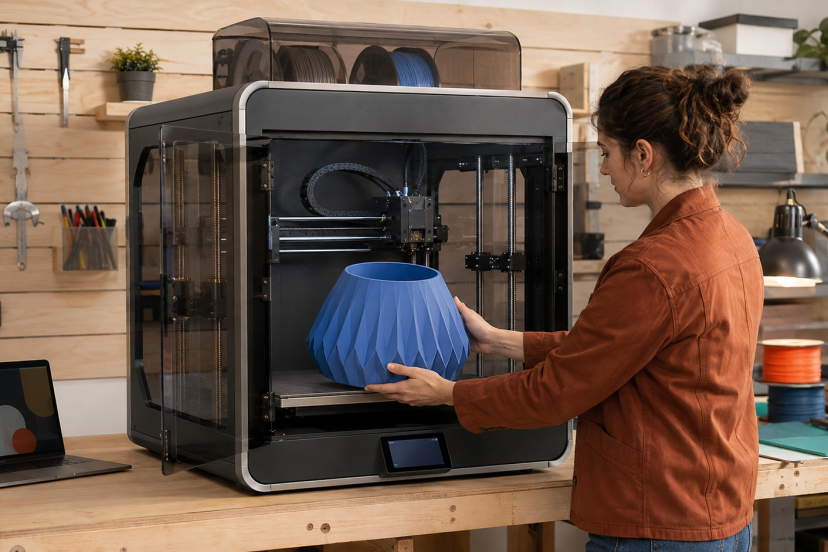
Printing a full-size helmet, large prototype, or production batch is much easier when you are not constantly cutting models into smaller sections. The best large format 3D printers combine a spacious build volume with reliable leveling, stable motion, and enough extrusion power to finish demanding projects.
This guide compares ten strong options available through Amazon. Whether you prioritize maximum build space, an enclosed chamber, multicolor printing, or affordability, there is a machine here for your workflow.
Our Top Picks
| Product | Best For | Key Feature | Rating | Read More |
| Creality K2 Plus Combo | Best overall | Enclosed 350 mm cube with multicolor support | ★★★★★ | Read more |
| ELEGOO Neptune 4 Max | Best value | Huge 420 × 420 × 480 mm capacity | ★★★★⯪ | Read more |
| Anycubic Kobra 3 Max | Cosplay projects | 420 × 420 × 500 mm build volume | ★★★★⯪ | Read more |
| Creality Ender-5 Max | Print farms | Stable 400 mm cubic frame | ★★★★⯪ | Read more |
| Sovol SV08 Max | Maximum capacity | Massive 500 mm cubic volume | ★★★★⯪ | Read more |
| QIDI Max4 Combo | Engineering-grade prints | 390 × 390 × 340 mm volume with heated chamber | ★★★★⯪ | Read more |
| Snapmaker Artisan | Large dual-material projects | Up to 400 × 400 × 400 mm build area with dual extrusion | ★★★★⯪ | Read more |
| Longer LK5 Pro | Beginners on a budget | Accessible 300 × 300 × 400 mm platform | ★★★★☆ | Read more |
| Creality Ender-3 V3 Plus | Everyday large prints | Fast CoreXZ motion system | ★★★★☆ | Read more |
| Sovol SV06 Plus ACE | Open-source enthusiasts | Direct drive and Klipper-based controls | ★★★★☆ | Read more |
Top 10 Large Format 3D Printers Reviewed
1. Creality K2 Plus Combo
Best for: Buyers wanting a complete premium package
Key features: 350 × 350 × 350 mm volume, enclosed chamber, multicolor capability, automatic calibration

The Creality K2 Plus Combo is our best overall choice because it provides generous capacity without sacrificing automation or material versatility. Its rigid CoreXY frame and enclosed, actively heated chamber make it suitable for PLA and PETG as well as demanding materials such as ABS and ASA.
The included Creality Filament System handles multicolor projects with fewer manual filament changes. Its 350 mm cubic volume is smaller than some open-frame giants, but the controlled chamber makes more of that space usable for warp-prone materials.
Pros:
- Enclosed chamber supports more filament types
- Automatic leveling and monitoring reduce setup
- Multicolor printing through the CFS
- Stable frame for fast movement
Cons:
- Large, heavy desktop footprint
- Higher investment than open-frame machines
2. ELEGOO Neptune 4 Max
Best for: Maximum print volume at a reasonable cost
Key features: 420 × 420 × 480 mm volume, Klipper firmware, direct-drive extruder, automatic leveling
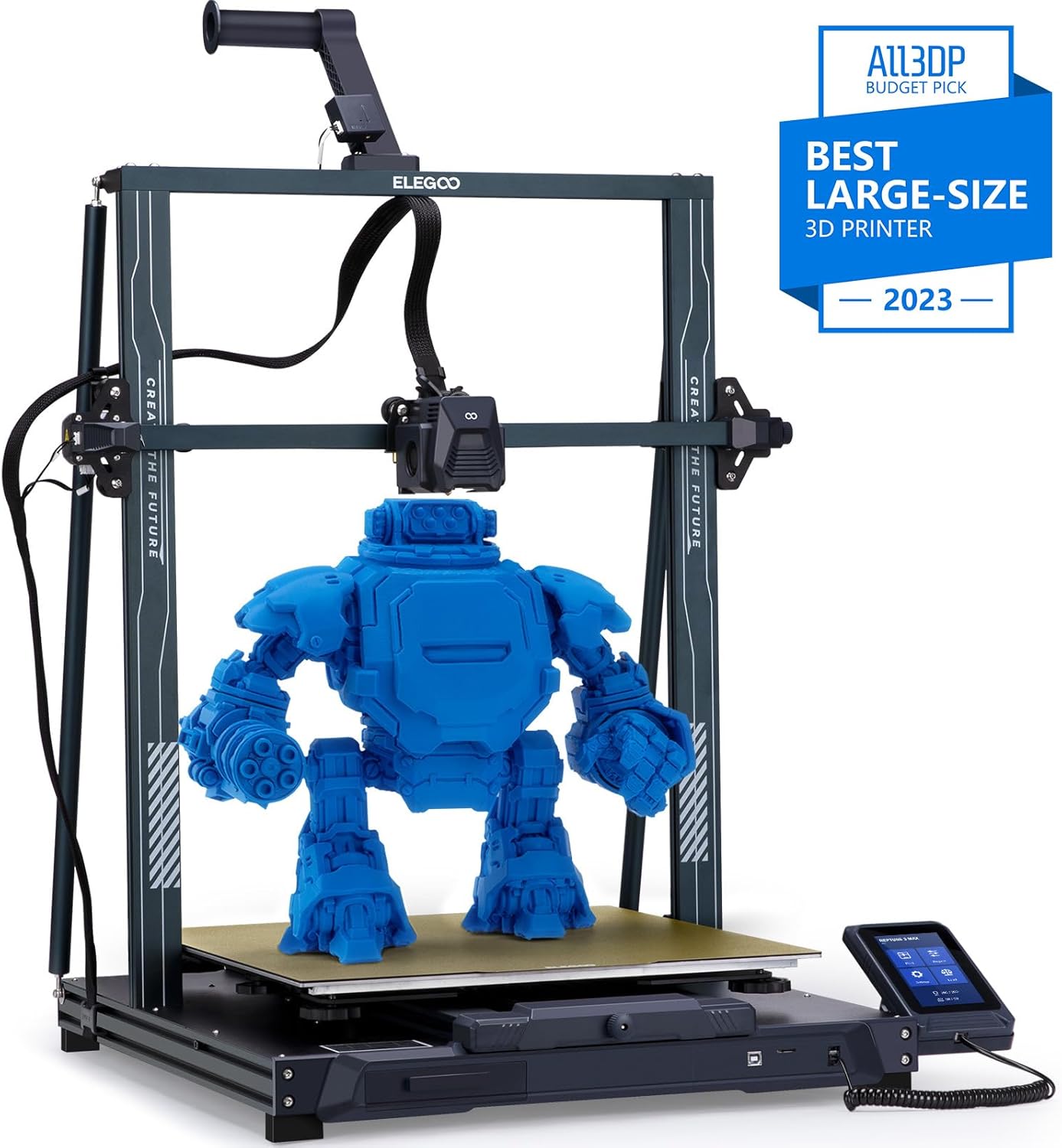
The Neptune 4 Max offers one of the best size-to-cost ratios in this roundup. Its build area can accommodate large helmets, armor components, display models, and batches of smaller pieces.
Klipper-based controls allow faster printing than older oversized bed-slingers, while the direct-drive extruder improves filament control. However, a bed this large requires careful leveling, adequate room behind the machine, and realistic speed settings during tall prints.
Pros:
- Exceptional build capacity for the money
- Direct-drive extrusion
- Network-based Klipper interface
- Suitable for one-piece cosplay components
Cons:
- Large moving bed needs considerable clearance
- Calibration can take time
3. Anycubic Kobra 3 Max
Best for: Cosplay, props, and multicolor-ready projects
Key features: 420 × 420 × 500 mm volume, automatic leveling, vibration compensation, optional multicolor system

Anycubic’s Kobra 3 Max gives prop makers a very useful combination of width and height. The 500 mm Z capacity is especially valuable for masks, sculptures, architectural models, and tall enclosures.
It can also work with Anycubic’s ACE Pro system for multicolor printing and filament management. As with any oversized bed-slinger, the advertised maximum speed is less important than stable acceleration and a dependable first layer.
Pros:
- Excellent capacity for tall models
- Automated bed leveling
- Optional multicolor printing
- Anti-skip and vibration-control features
Cons:
- Needs a deep, sturdy work surface
- Large multicolor prints can generate substantial waste
4. Creality Ender-5 Max
Best for: Workshops and small print farms
Key features: 400 × 400 × 400 mm volume, rigid cubic frame, 64-point leveling, network management

Unlike large machines that move the entire bed rapidly along the Y axis, the Ender-5 Max uses a box-style structure designed to keep motion more controlled. That makes it attractive for workshops producing large prototypes or multiple components per plate.
Its network controls can also help users manage several machines. The printer remains open-frame, however, so ABS and similar materials may require a compatible enclosure.
Pros:
- Stable all-metal frame
- Large cubic capacity
- Automatic bed leveling
- Suitable for batch production
Cons:
- Open frame limits temperature control
- Requires substantial vertical and horizontal space
5. Sovol SV08 Max
Best for: Users needing the biggest practical desktop build area
Key features: 500 × 500 × 500 mm capacity, CoreXY design, high-flow extrusion, open-source platform

The SV08 Max enters genuinely oversized territory with its half-meter cubic build volume. It is intended for users creating large props, furniture prototypes, molds, signs, or industrial-scale concept models.
Its CoreXY motion system is better suited to this capacity than a conventional moving-bed design. The tradeoff is that a 500 mm machine demands a dedicated location, plenty of filament, and careful preparation before committing to multi-day prints.
Pros:
- Enormous half-meter build capacity
- CoreXY motion system
- Open-source, modification-friendly design
- Can reduce the need to split models
Cons:
- Too large for many home workspaces
- Newer model with a shorter ownership history
6. QIDI Max4 Combo 3D Printer
Best for: Large engineering-grade prints
Key features: 390 × 390 × 340 mm volume, 65°C heated chamber, 800 mm/s maximum speed, 16-color support

The QIDI Max4 Combo combines a spacious build volume with an enclosed CoreXY structure and closed-loop motors for fast, stable printing. Its automatic bed leveling and heated chamber help reduce warping across large models.
The 370°C hotend supports PLA, PETG, ABS, nylon, polycarbonate, and reinforced composites. Its included QIDI Box also enables multicolor and multi-material printing, making the machine suitable for complex prototypes and production parts.
Pros:
- Large enclosed build area
- Actively heated chamber
- Supports up to 16 colors
- Handles engineering-grade materials
Cons:
- Heavy and requires substantial workspace
- Higher cost than open-frame printers
7. Snapmaker Artisan 3D Printer
Best for: Large dual-material projects
Key features: Up to 400 × 400 × 400 mm volume, dual extrusion, automatic leveling, enclosed design
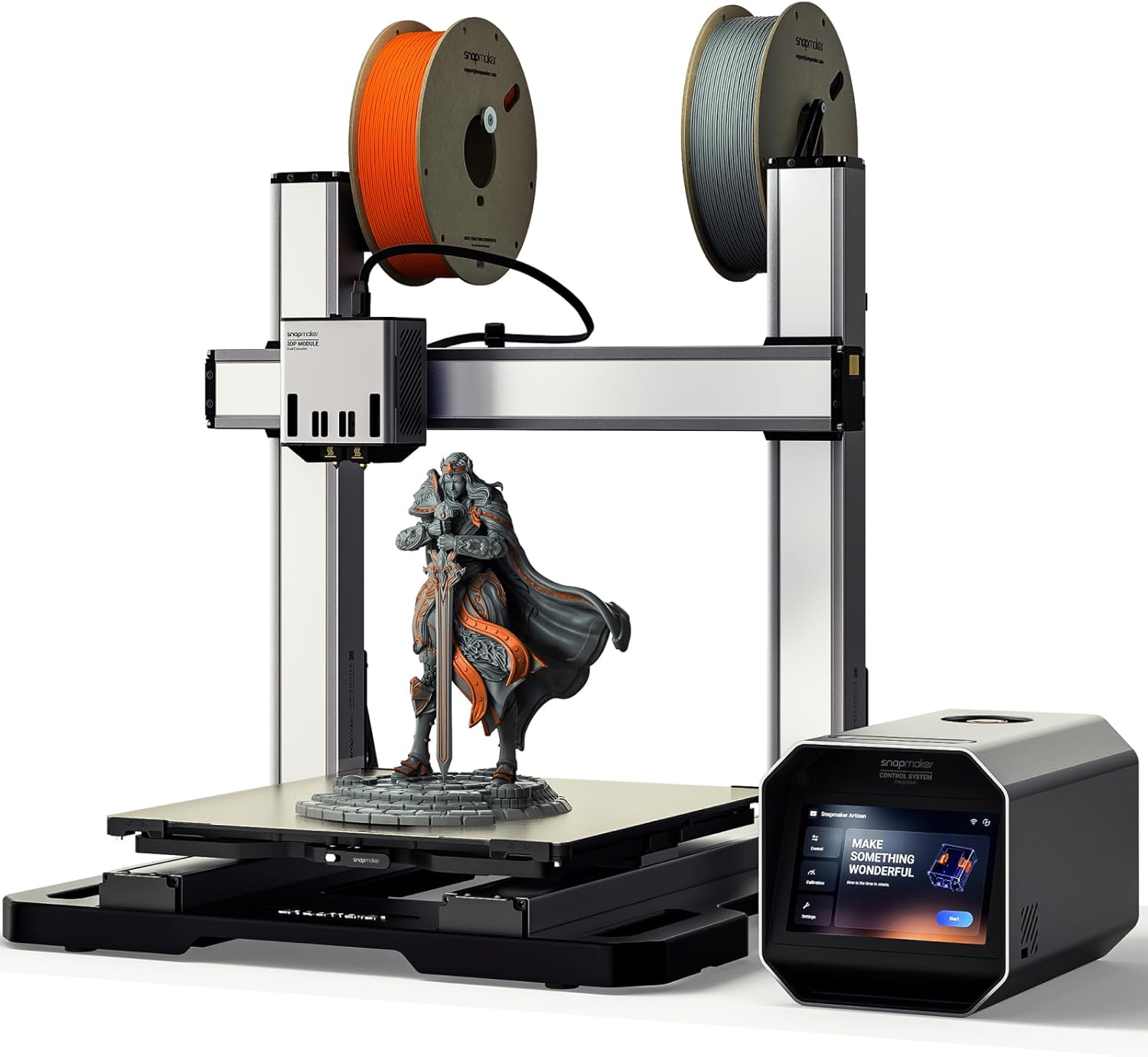
The Snapmaker Artisan provides a generous print area for large prototypes, cosplay parts, architectural models, and production batches. Its rigid all-metal construction and automatic leveling help maintain accuracy across the oversized build plate.
The dual-extrusion system supports two-color printing, soluble supports, and material combinations. Its 300°C hotend works with PLA, PETG, TPU, ABS, ASA, nylon, and compatible fiber-reinforced filaments.
Pros:
- Large 400 mm build area
- Dual-color and dual-material printing
- Enclosed all-metal construction
- Supports advanced filament types
Cons:
- Dual-nozzle mode reduces the usable width
- Large, heavy, and relatively expensive
8. Longer LK5 Pro
Best for: Budget-conscious beginners
Key features: 300 × 300 × 400 mm volume, triangular frame braces, filament sensor, resume printing

The Longer LK5 Pro is not the fastest or most automated machine here, but it provides useful extra capacity at an approachable price. Its 400 mm height works well for vases, costume pieces, sculptures, and basic prototypes.
This is a better fit for hobbyists who do not mind learning manual calibration and slower print profiles. The reinforced frame helps with tall models, although newer printers offer more convenient leveling systems.
Pros:
- Affordable entry into large-format printing
- Useful 400 mm vertical capacity
- Reinforced frame
- Filament runout and power-loss recovery
Cons:
- Older control and motion technology
- More manual setup than newer models
9. Creality Ender-3 V3 Plus
Best for: Everyday projects needing moderate extra room
Key features: 300 × 300 × 330 mm volume, CoreXZ motion, direct drive, automatic calibration
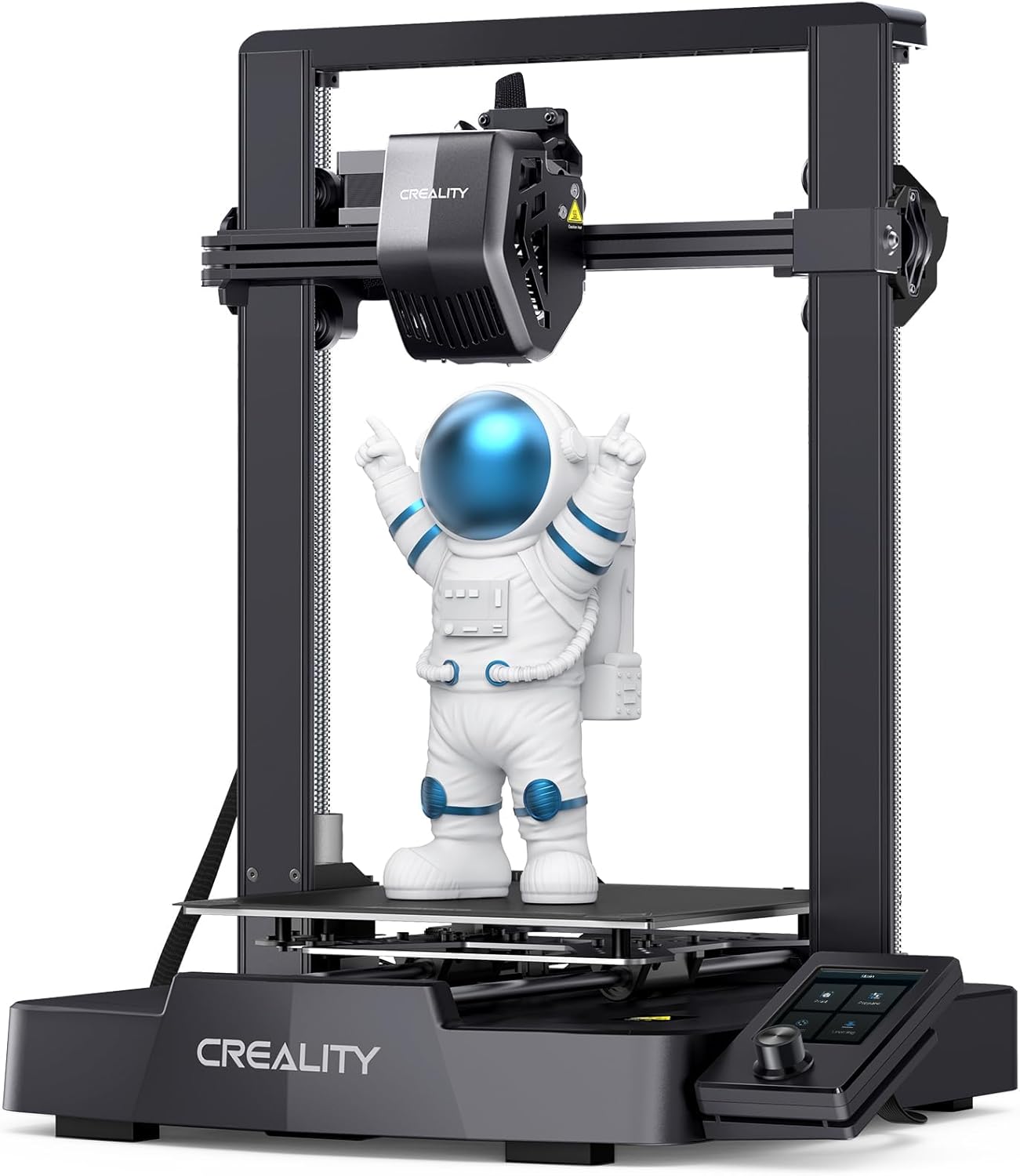
The Ender-3 V3 Plus is a sensible middle ground between ordinary desktop printers and workshop-sized machines. Its 300 mm bed is large enough for many helmets, household parts, and grouped components without dominating an entire room.
CoreXZ motion and automatic calibration give it a more modern feel than earlier Ender models. It is still open-frame, making it most comfortable with PLA, PETG, and TPU unless you add environmental control.
Pros:
- Manageable footprint for its capacity
- Fast CoreXZ design
- Straightforward automatic calibration
- Broad Creality parts community
Cons:
- Not large enough for the biggest props
- No built-in enclosure
10. Sovol T300 3D Printer
Best for: Fast large-format printing
Key features: 300 × 300 × 350 mm volume, Klipper firmware, 600 mm/s maximum speed, automatic leveling

The Sovol T300 pairs a spacious build area with Klipper firmware, input shaping, and pressure advance for faster, more controlled printing. Its all-metal frame and industrial linear rails provide the stability needed for tall models, prototypes, and batches of smaller parts.
The 300°C hotend handles popular materials such as PLA, PETG, TPU, and ABS. It also arrives 95% assembled, although reaching its highest speeds may require careful tuning and suitable slicer settings.
Pros:
- Spacious build volume
- Fast Klipper-based performance
- 81-point automatic leveling
- Stable industrial linear rails
Cons:
- Open frame offers limited temperature control
- High-speed printing may require tuning
How to Choose Large Format 3D Printers
Start with the largest object you regularly expect to print. A 300 mm bed is sufficient for many helmets and prototypes, while 400–500 mm machines make sense for full props, signage, molds, and large functional parts.
Also consider:
- Printer footprint: Moving-bed models need additional clearance in front and behind.
- Frame design: CoreXY and cubic frames generally control high-speed movement better.
- Enclosure: Choose an enclosed machine for ABS, ASA, nylon, and other warp-prone materials.
- Bed leveling: Automatic mesh leveling is especially valuable on a 400 mm or larger plate.
- Filament use: Large prints can consume several spools, so runout detection is essential.
- Nozzle size: A 0.6 mm or 0.8 mm nozzle can shorten oversized print times considerably.
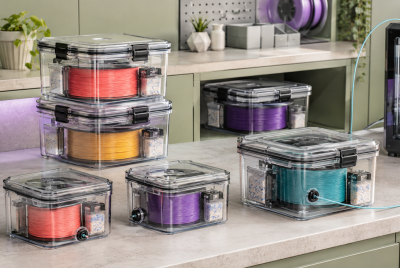
Large projects also magnify filament problems. Review this guide to choosing the right 3D printer filament before committing to a multi-day job. A dependable filament dryer and other 3D printer accessories can help prevent moisture-related defects during long prints.
Final Thoughts
The best large format 3D printers provide more than an impressive build-volume number—they need stable motion, reliable leveling, and dependable extrusion throughout long jobs. The Creality K2 Plus Combo is the strongest all-around option for buyers who value an enclosure, automation, and multicolor support. Choose the ELEGOO Neptune 4 Max for maximum value, the Anycubic Kobra 3 Max for tall cosplay builds, or the Sovol SV08 Max when a half-meter print volume is the deciding factor.
Frequently Asked Questions
What qualifies as large format 3D printers?
For consumer FDM printing, a machine with at least one build dimension of approximately 300 mm is commonly considered large format. Industrial definitions vary, and professional machines can offer build volumes exceeding one meter.
What is the best large format 3D printer for cosplay?
The ELEGOO Neptune 4 Max and Anycubic Kobra 3 Max are strong large format 3D printers choices because their 420 mm beds can accommodate many helmets and armor pieces. The enclosed Creality K2 Plus is better when material versatility matters more than maximum size.
Are large format 3D printers harder to use?
They can be. Large beds take longer to heat and level, while tall prints magnify vibration, warping, and calibration errors. Automatic leveling, a rigid frame, and conservative speed settings make them easier to manage.
Can a large format printer create furniture?
A half-meter machine can produce stools, organizers, lamp structures, furniture connectors, and prototype components. Full-size furniture usually requires modular sections, significant filament, and materials selected for the expected load.
Is CoreXY better for large 3D printing?
CoreXY is often preferable for fast, large prints because the heavy build plate does not move rapidly back and forth. However, a well-tuned bed-slinger can still produce excellent oversized models at more moderate speeds.