Everyday Useful 3D Prints You Didn’t Know You Needed
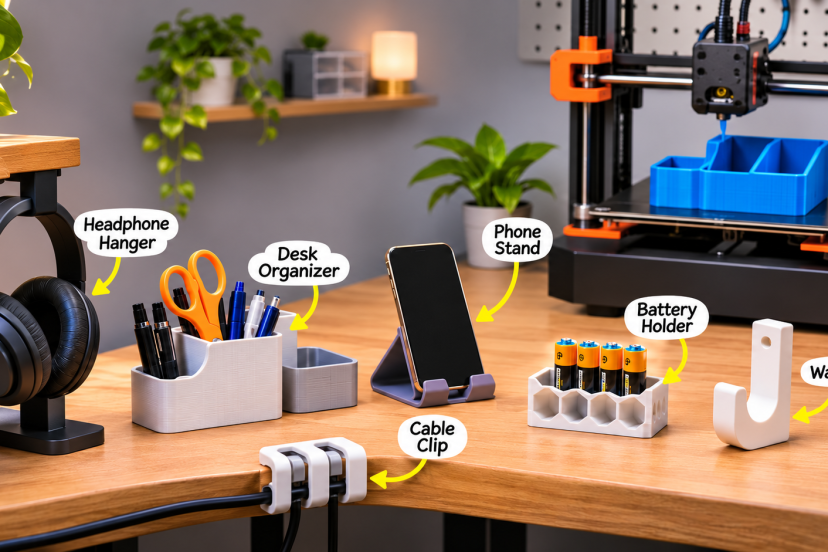
A 3D printer becomes a lot more interesting once you stop thinking only about display models and start noticing small annoyances around the house. A cable that keeps falling behind the desk, batteries rolling around a drawer, or a missing plastic knob can all become quick printing projects. Some of the best useful 3D prints are surprisingly simple. They solve one specific problem, fit your space better than a mass-produced alternative, and can often be adjusted when the first version is not quite right. Here are practical ideas that can turn your printer into an everyday problem-solving tool.
What Makes a 3D Print Truly Useful?
A functional print does not have to be complicated. In many cases, the most useful models have a simple job: hold, organize, space, guide, protect, or replace something.
What makes 3D printing particularly useful is customization. Instead of buying a generic cable holder that almost fits your desk, you can print one sized for the exact cable and surface you use.
Good everyday projects usually share a few qualities:
- They solve a recurring problem.
- They require relatively little material.
- Their dimensions can be customized.
- They are easy to reprint if damaged.
- They do not perform a safety-critical job.
Once you start looking at objects this way, potential projects appear everywhere.
Useful 3D Prints for Your Desk and Workspace
Desks collect small problems surprisingly quickly. Cables move, headphones take up space, pens disappear, and chargers somehow end up in a pile.
Cable Clips and Routing Guides
Cable clips are among the easiest functional prints to justify. You can size them for USB cables, charging cords, Ethernet cables, or thicker power leads.
A few small clips attached along the back or underside of a desk can keep cables separated and stop frequently used cords from dropping to the floor.
Headphone Hangers
Instead of leaving headphones on the desk, print a hanger that mounts beneath the tabletop or attaches to the side of a shelf. A custom version can match the exact thickness of your desk rather than relying on a generic clamp.
Drawer Dividers
Modular dividers are especially useful because you can design the compartments around what you actually own. Calipers, SD cards, screws, USB drives, pens, and printer tools can each have their own space.
Practical Prints for the Kitchen and Home
Not every household print needs to be a complicated mechanical project.
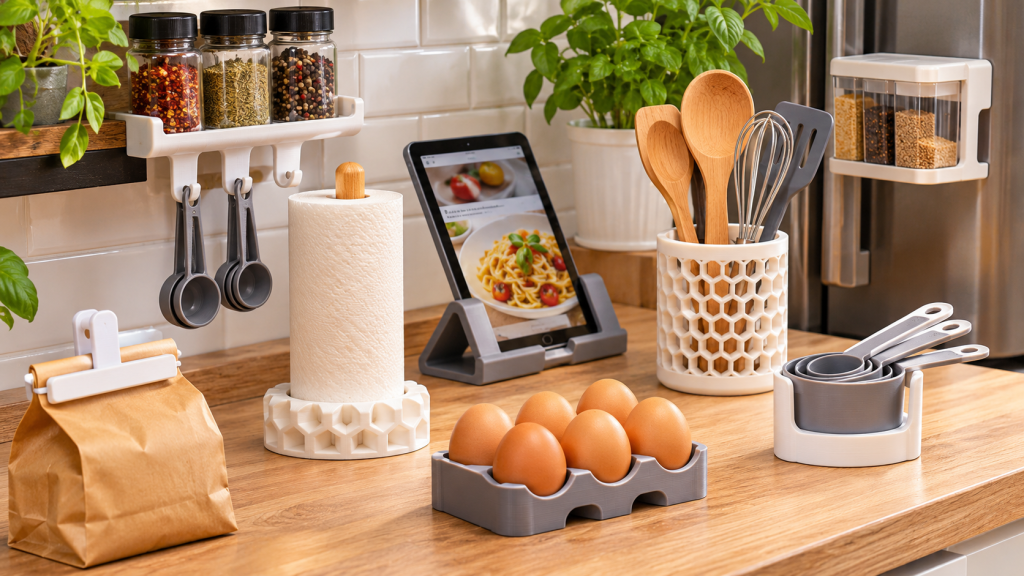
Bag clips, wall hooks, remote-control holders, drawer organizers, toothbrush stands, plant-pot accessories, and small storage bins can all be useful when designed for the right environment.
One particularly handy project is a custom wall-mounted holder. Measuring the item first lets you create a bracket that fits a flashlight, remote, small vacuum attachment, controller, or other object with very little wasted space.
Just consider temperature, moisture, loading, and hygiene before choosing a filament. PLA is easy to print but is not ideal for every warm or demanding environment. PETG offers better toughness and temperature resistance for many functional applications. Prusa describes PETG as particularly suitable for holders, clamps, mechanical components, and other technical parts.
Garage and Workshop Prints Worth Making
The workshop is where functional printing really starts earning its keep.
Tool Holders
Instead of searching through a drawer for every hex key, screwdriver, or drill bit, you can print dedicated holders and wall-mounted organizers.
Pegboard accessories are another good project because you can modify the mounting system around your specific tools instead of relying entirely on standard hooks.
Battery Holders
Loose AA, AAA, 18650, camera, and power-tool batteries are awkward to organize. Printed holders can keep them upright, separated, and easy to count.
For rechargeable cells, design the holder so terminals cannot accidentally contact conductive objects.
Drill Guides and Assembly Jigs
Simple jigs can help position holes, align components, or hold pieces consistently during assembly. These are some of the most valuable useful 3D prints because the object does not need to look beautiful—it simply needs to make another task easier.
Small Replacement Parts That Save the Day
A broken piece of plastic can make an otherwise functional product frustrating to use.
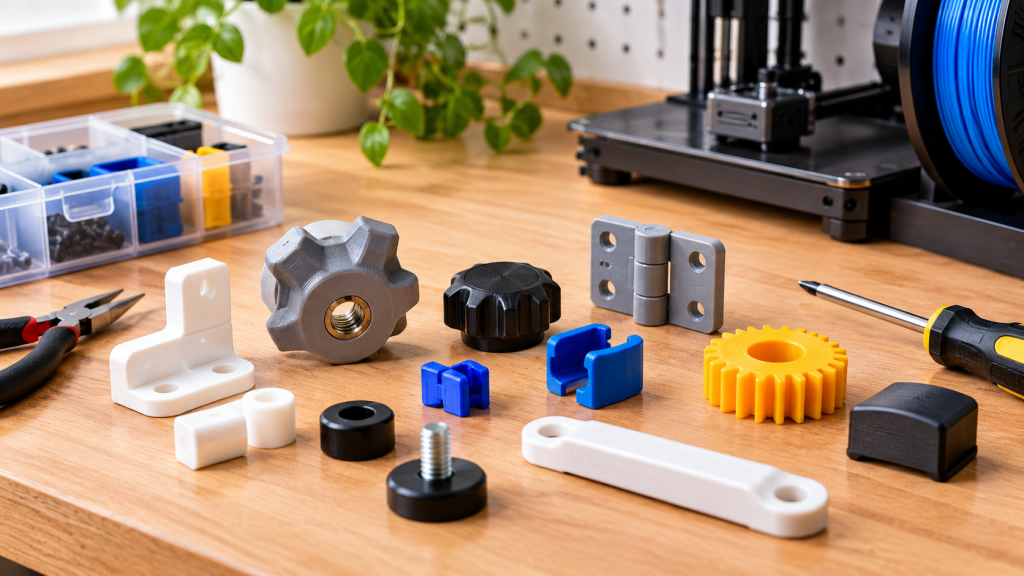
Replacement knobs, spacers, feet, caps, clips, covers, handles, and brackets are all good candidates for 3D printing when failure would not create a serious safety risk.
This is also where digital calipers become extremely useful. Measure the original part, model the important dimensions, print a quick prototype, and adjust the design based on fit.
Your first print does not need to come out perfectly. One of the advantages of desktop 3D printing is that changing a hole by 0.3 mm or thickening a wall takes far less effort than trying to modify a commercial replacement.
Useful Prints for Tech and Electronics
Electronics create plenty of opportunities for customized accessories.
Phone stands are an obvious example, but you can also print:
- Raspberry Pi and microcontroller enclosures
- Router wall mounts
- Cable strain-relief guides
- Webcam mounts
- Controller stands
- SD card organizers
- Charging-dock holders
- Under-desk power-strip brackets
Ventilation matters when printing electronics enclosures. Leave enough space around components that generate heat, and avoid positioning plastic directly against surfaces that may exceed the filament’s safe working temperature.
How to Make Functional 3D Prints Last Longer
A useful model can still fail quickly if it is printed in the wrong orientation.
FDM parts are built from individual layers, so strength is directional. Loads that try to separate those layers can cause failure more easily than forces running along them. UltiMaker’s FFF design guidance recommends considering orientation early because it affects both mechanical performance and support requirements.
For stronger everyday prints:
- Orient the model around the direction of expected force.
- Add extra walls or perimeters before automatically choosing extreme infill.
- Use fillets or ribs around stressed corners when the design allows.
- Select filament based on the environment, not just printability.
- Avoid unnecessarily thin mounting points.
Prusa also recommends increasing perimeters when stronger PETG parts are needed rather than relying only on additional infill.
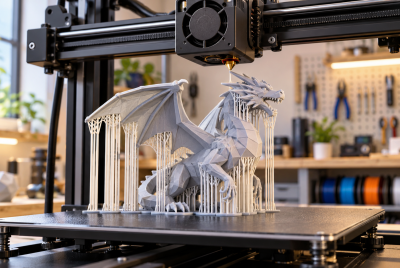
Complex functional models may also require temporary support structures. If overhangs are creating rough surfaces or difficult cleanup, this guide to 3D printing supports covers practical orientation and support-setting techniques.
If you are batch-printing organizers or other straightforward parts, adjusting your 3D printing speed carefully can also reduce production time without sacrificing reliability.
Best Products for Functional 3D Printing
1. Digital Caliper – Accurate measurements make replacement parts and custom-fit accessories much easier to design. A digital caliper is particularly useful for measuring holes, shafts, wall thicknesses, and existing components.
2. OVERTURE PETG Filament – PETG is worth keeping around when a project needs more toughness or temperature resistance than a typical decorative PLA print. It works well for many holders, brackets, organizers, and workshop accessories.
3. Hakko CHP-170 Micro Cutter – Flush cutters make short work of filament ends, thin support structures, brims, and small pieces of unwanted plastic. The CHP-170 uses a compact angled head that can reach close to printed surfaces.
4. AFA Tooling Deburring Tool – A deburring tool is handy for cleaning rough holes, brim remnants, support marks, and sharp plastic edges. Use light pressure so you remove only the material you intend to trim.
5. 3M Protective Eyewear – Support pieces and trimmed plastic can sometimes snap away unexpectedly during post-processing. Basic eye protection is a sensible addition to a workstation where prints are regularly cut, drilled, or cleaned.
Credible References
The Prusa Filament Material Guide provides a useful comparison of common printing materials, including their temperature resistance, mechanical suitability, print requirements, and other practical characteristics.
UltiMaker’s Design for FFF 3D Printing guide explains how orientation, wall thickness, support requirements, and part geometry affect functional FDM prints.
Conclusion
Useful 3D prints are rarely the biggest or most complicated objects coming off a printer. A well-fitted cable clip, replacement knob, battery organizer, mounting bracket, or workshop jig may save more frustration than an elaborate model that sits on a shelf. Start by looking for one small problem you deal with repeatedly. Measure it, print a simple solution, test the fit, and improve the design if necessary. That cycle of noticing, making, and refining is where a 3D printer becomes genuinely useful.
FAQs
Which 3D prints are the most practical for everyday use?
Cable organizers, tool holders, drawer dividers, wall mounts, replacement knobs, battery holders, electronics enclosures, jigs, spacers, and custom brackets are among the most practical everyday prints.
Is PLA strong enough for functional prints?
Yes, for many low-load indoor applications. PLA prints easily and can produce rigid parts, but PETG, ASA, nylon, or other engineering materials may be better when heat, impact, weather, or higher mechanical loads are involved.
How much infill should I use for useful 3D prints?
There is no single ideal percentage. Many functional prints benefit more from additional walls and good orientation than extremely high infill. Increase infill only when the load and geometry justify it.
Where can I download practical 3D printing models?
Popular model repositories include Printables, MakerWorld, Thingiverse, and Thangs. Check dimensions, comments, material recommendations, and licensing before printing or modifying a design.
Can useful 3D prints replace store-bought parts?
Sometimes. Simple clips, organizers, knobs, spacers, brackets, and covers are good candidates. Avoid replacing safety-critical or heavily loaded parts unless the design, material, loading conditions, and testing are properly understood.