5 3D Printed Storage Boxes to Organize Your Home
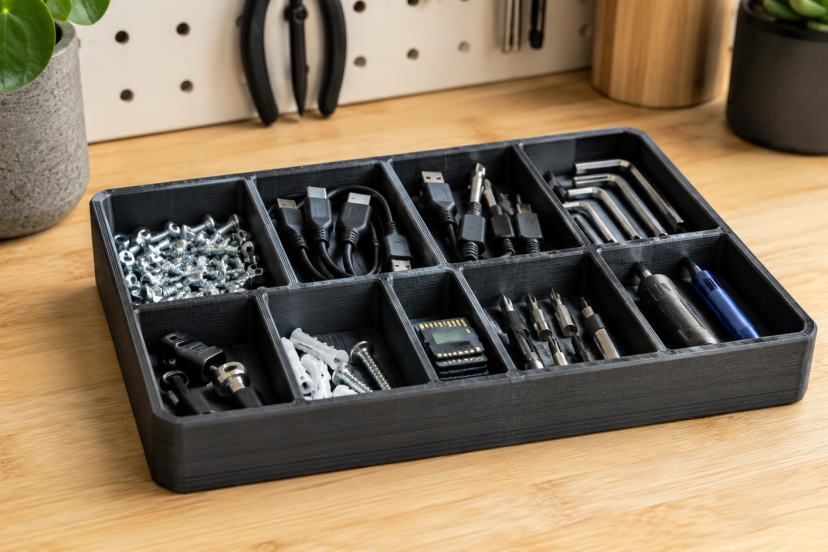
When small things have no place to go, they accumulate quickly. Screws, cables, craft supplies, tools, and other desk items can quickly make a clean area look dirty. This is exactly where 3D printed storage boxes become useful. They allow you to design custom organizers for your specific needs, such as a drawer divider, stackable box, cable holder or even a 3D printing accessory storage. Today, we are going to discuss five useful storage ideas that will allow you sort out your home smarter, cleaner, and a lot more customized to your preferences.
Why 3D Printed Storage Boxes Are Worth Making
Store-bought organizers are useful, but they rarely fit perfectly. One tray is too tall, another is too shallow, and the compartments may not match what you actually need to store.
3D printed storage boxes solve that problem. You can print boxes in the exact size, shape, and layout you want, whether you need a tiny screw bin, a cable box, or a stackable container for a narrow shelf.
Modular systems like Gridfinity make this even easier. The unofficial Gridfinity wiki describes it as a free, open-source, almost fully 3D printable storage system built around a modular 42 mm grid. In addition, a detailed Design for Additive Manufacturing review explains that 3D printing supports complex shapes, customized products, and small-series manufacturing, which is why custom storage boxes make so much sense for home makers.
What to Consider Before Printing Storage Boxes
Before you hit print, think about how the box will actually be used. A box for cotton swabs does not need the same strength as a box full of steel bolts.
Choose the Right Material
PLA is the easiest choice for most indoor storage boxes. It prints cleanly, holds detail well, and works nicely for drawer trays, craft bins, office organizers, and decorative boxes.
PETG is better when you need more toughness or a little flexibility. It is a smart option for garage storage, toolboxes, cable bins, and boxes that may get bumped around.
ABS or ASA can work for more demanding use, but they require better ventilation and printer control. For everyday home organization, most people can start with PLA or PETG and be perfectly happy.
Use Practical Wall Thickness and Infill
For small drawer boxes, 2–3 walls and 10–20% infill are usually enough. For heavier items like screws, sockets, drill bits, or printer tools, go stronger. Add thicker walls, increase bottom layers, and use more infill.
Print settings matter because they affect strength. A systematic review of PLA printing parameters found that factors such as layer thickness, print speed, temperature, build orientation, and raster angle can influence the mechanical properties of PLA printed parts.
Think About Lids, Labels, and Stackability
A lid sounds simple until you print one that is too tight. For storage boxes, aim for a lid that slides, snaps lightly, or rests securely without needing a wrestling match.
Labels are also worth planning early. You can emboss text, add a label slot, or print removable tags. For home organization, labels save future-you from opening six boxes just to find one Allen key.
Stackability matters too. If boxes will sit on a shelf, add recessed bottoms or small corner lips so they nest safely. A stack that slides around is not organization. It is just clutter with extra steps.
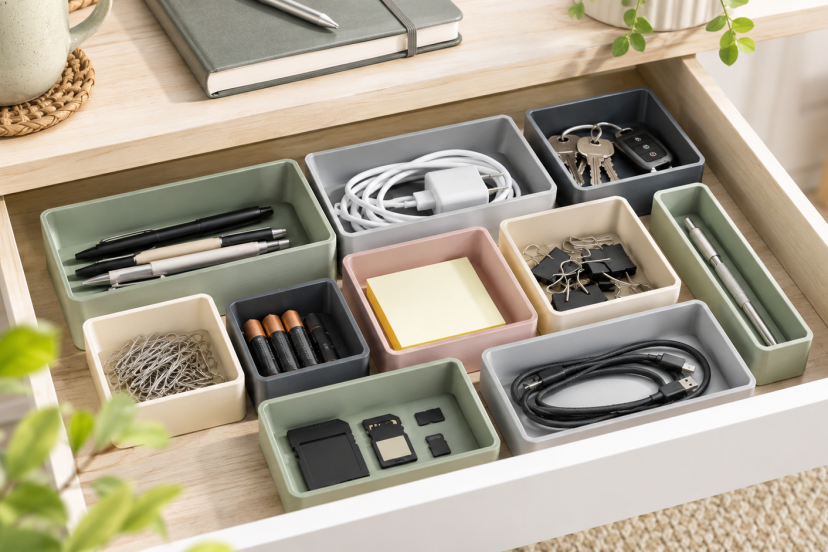
1. Modular Drawer Divider Boxes
Modular drawer divider boxes are one of the easiest 3D printed storage projects to start with. They are small, quick to print, and useful right away.
They work well in:
- Kitchen junk drawers
- Office drawers
- Nightstands
- Bathroom cabinets
- Maker desks
- Tool drawers
Instead of using one large tray with fixed compartments, print smaller boxes that match your actual items. For example, you can make:
- A long box for pens
- A shallow square box for SD cards
- A narrow bin for batteries
- A deeper box for keys, clips, or tape rolls
This keeps your drawer flexible. When your needs change, you can reprint one box instead of replacing the whole organizer.
For drawer storage, open-top boxes usually work best. They make it easy to grab what you need without removing a lid.
For a clean look, print all boxes in one color. If you wish to have a better organization, use color coding. For example, blue for tech items, white for office supplies, and orange for tools.
2. Stackable Small Parts Storage Boxes
Stackable small parts boxes are perfect for makers, DIYers, and anyone with too many tiny pieces to keep track of.
Use them for:
- Screws and bolts
- Nuts and washers
- Wall anchors
- Electronic components
- Sewing clips
- Beads and hooks
- Replacement parts
- 3D printer nozzles and fittings
The best designs include a secure lid, a flat label area, and a stacking feature. A small lip on the lid helps the next box sit neatly on top, which saves space on shelves or workbenches.
3D printed versions also give you more control than basic plastic organizers. You can print tiny boxes for M2 screws, deeper boxes for larger hardware, or divided boxes for mixed kits.
For heavier parts, use PETG or a strong PLA blend. Also, avoid very thin walls. Small hardware can put more stress on a box than you might expect.
3. Cable and Charger Storage Boxes
Cable clutter builds up fast. One day you have two charging cords. Then suddenly you have USB-C cables, HDMI cords, adapters, power bricks, and a mystery cable no one can identify.
A 3D printed cable storage box helps keep that mess under control.
For cables, choose a wider box with rounded inside corners. Sharp corners can bend cords too tightly. You can also add:
- Small divider channels
- Labeled sections
- A sliding or snap-on lid
- Front slots for cable ends
Labels are especially helpful for tech storage. Use simple text like USB-C, HDMI, Audio, Camera, or Travel.
For chargers and adapters, print deeper compartments. If you travel often, make a small grab-and-go box for one wall plug, one power bank cable, and one spare adapter.
A front slot is a small but useful detail. It lets you see which cable is inside without opening every box.
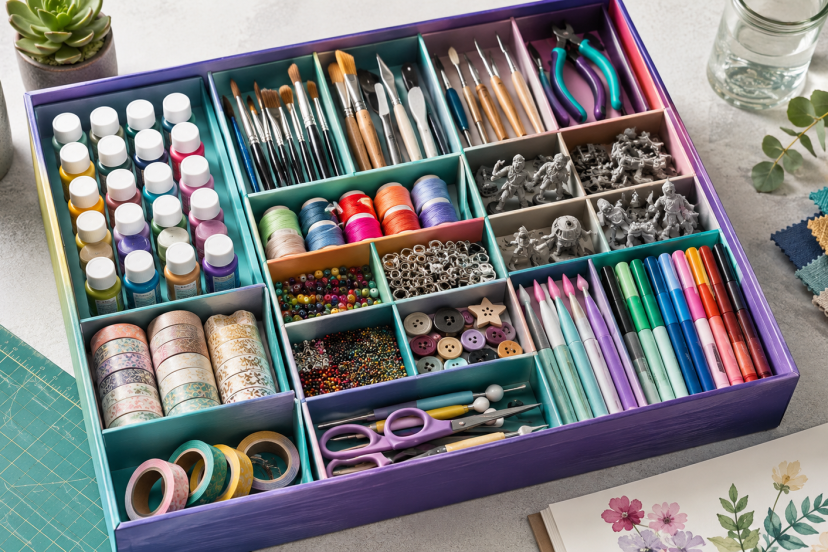
4. Craft and Hobby Supply Boxes
Craft and hobby supplies are easy to lose because many of them are small. Paint caps, brush tips, beads, pins, stickers, jewelry findings, clay cutters, and model parts can disappear quickly.
Craft storage boxes should focus on two things:
- Visibility
- Separation
Use shallow compartments for tiny items and deeper sections for larger tools. If you paint miniatures, print boxes that hold paint bottles upright. If you make jewelry, use divided boxes with rounded scoop bottoms so beads are easier to remove.
Instead of printing one large organizer, try making themed boxes. For example:
- Painting box
- Sanding box
- Jewelry box
- Sewing box
- Spare blades and tool box
This makes cleanup easier. You can grab the box for the project, use what you need, then put the whole thing away.
5. Filament and 3D Printing Accessory Boxes
If you own a 3D printer, you know how fast accessories pile up. Nozzles, scrapers, hex keys, glue sticks, cutters, filament clips, calibration tools, desiccant packs, and spare parts can take over your workspace.
A dedicated 3D printing accessory box keeps everything easier to find.
A good layout can include:
- Small compartments for nozzles
- A longer slot for tweezers or a deburring tool
- A section for spare parts
- A spot for glue sticks or clips
- A separate area for used nozzles
You can also print filament sample boxes. These are useful if you test different colors or materials. Add labels for PLA, PETG, TPU, matte, silk, wood-filled, or specialty blends.
For full filament spools, airtight storage matters more than appearance. Filament can absorb moisture over time, which may affect print quality. For bulk storage, use sealed bags, dry boxes, or airtight containers with desiccant packs.
If you enjoy experimenting with different printing technologies, you may also like this guide to a ceramic 3D printer and how ceramic printing differs from standard filament-based projects.
Recommended Products
Here are five products that pair well with 3D printed storage boxes, especially if you organize printer accessories, hardware, craft supplies, or filament.
- Mini Storage Containers with Lids
Good for small hardware, miniature parts, craft supplies, and desk clutter. The listing describes them as 3D printed containers with stackable storage use. - 3D Printing Desk & Tool Organizer
A fun desktop organizer for pens, tools, screws, remotes, watches, keys, and everyday accessories. - M3 Bolt Sorter, Screw Length Sorter Tray
Helpful for makers who sort M3 screws and hardware for printer builds, repairs, and electronics projects. - Sorting Tray with Slide Outlet for Small Parts
Useful for screws, nuts, beads, washers, and other small parts that need sorting before they go into storage boxes. - Qozary Filament Storage Box – 4 Pack
Best for filament organization. The product listing says the set can hold around 24 standard 1 kg spools and includes desiccant packs for humidity control.
Conclusion
3D printed storage boxes are an easy way to clean up the little clutter monsters that multiply in your drawers, bags, and closets. From drawer organizers and stackable hardware trays to cable organizers, craft storage, and 3D printing accessory bins, every design can be customized for your specific space and workflow. That’s what makes them so great for makers: you’re not just buying storage, you’re instituting a system that works with how you actually work and live. Start with one messy drawer or shelf, print a few useful boxes, and add to it from there. Small adjustments can turn a cramped space into something cleaner, more user-friendly, and a lot more rewarding.
FAQs
1. What is the best filament for 3D printed storage boxes?
PLA is best for most indoor storage boxes because it is easy to print and holds its shape well. PETG is better for boxes that need extra toughness, flexibility, or garage-friendly durability.
2. Are 3D printed storage boxes strong enough for tools?
Yes, as long as you design and print them properly. Use thicker walls, more bottom layers, and stronger infill for heavy tools or hardware. PETG is often a better choice than basic PLA for rougher use.
3. Can I make stackable 3D printed storage boxes?
Absolutely. Add a small raised lip on the lid or a recessed base so each box sits securely on the one below it. Keep the sides straight and avoid top-heavy designs.
4. Do 3D printed boxes need lids?
Not always. Open boxes work well inside drawers because they make items easy to grab. Lidded boxes are better for shelves, travel, dust protection, craft supplies, and small parts that spill easily.
5. Where can I find designs for 3D printed storage boxes?
You can find free and paid designs on popular 3D model platforms such as Printables, MakerWorld, Thingiverse, and Thangs. Search for terms like “drawer organizer,” “Gridfinity box,” “stackable storage box,” “small parts organizer,” or “cable storage box.”